🏗️ Construction & Real Estate
How Gulf Procurement Teams Are Sourcing Construction Materials in 2026
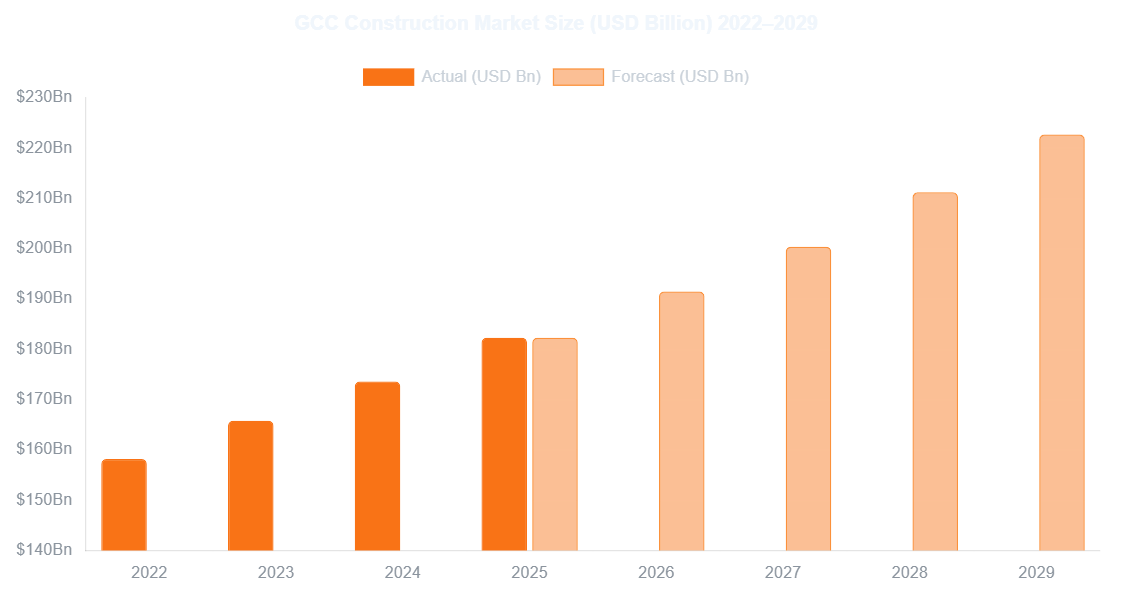
GCC Construction Market Size (USD Billion) 2022-2029. Sources: Morgan Reed Insights, Mordor Intelligence, IMARC Group. Forecasts from 2026.
The GCC construction sector crossed USD 191.5 billion in 2026. That number looks impressive on a conference slide — and it is — but for the procurement managers actually responsible for keeping job sites moving, it translates into something far more stressful: unprecedented demand for steel, cement, MEP equipment, and specialist materials, compressed timelines, and a supplier landscape that's simultaneously expanding and fragmenting.
I've spent enough time in Gulf procurement circles to know that the gap between project approval and material on-site is where most cost overruns actually happen. It's not the design. It's not even the labour. It's the three-week wait for a transformer that should have taken four days, or the cement batch that failed quality specs on arrival at a Saudi port. These aren't rare horror stories — they're routine, and in 2026 they're happening against a backdrop of mega-project pipelines that would have seemed fantastical a decade ago.
So let's talk about what's actually working for procurement teams sourcing construction materials across the UAE, Saudi Arabia, Qatar, and the broader GCC right now.
The GCC construction market is valued at USD 191.5 billion in 2026, heading toward USD 278.5 billion by 2035 — a CAGR of 4.7% that puts it among the fastest-growing construction markets globally. Saudi Arabia alone accounts for USD 142.3 billion of that figure, driven by Vision 2030 mega-projects ranging from NEOM's linear city to Red Sea Global's 16-island resort complex, which received USD 3.9 billion in contracts in early 2026 alone.
When you're running procurement for even a mid-scale project in Riyadh or Dubai, you're competing with Emaar, ADNOC's construction arm, and Saudi Electricity Company — which has earmarked USD 126 billion in grid infrastructure through 2030 — all simultaneously. The suppliers who gave you a call-back within 24 hours are now fielding enquiries from project managers on three continents.
The GCC construction materials sub-market — worth USD 28.1 billion in 2025 and growing at 8.10% CAGR — reflects this pressure. Steel, ready-mix concrete, prefabricated structural elements, HVAC equipment, and specialist electrical components are all seeing lead-time extensions that weren't there two years ago. According to Linesight's 2026 Construction Market Outlook, tariff volatility and US-sourced component dependencies are reintroducing uncertainty after a period of relative stability.
"The problem isn't that suppliers don't exist. It's that procurement teams don't know which ones are active, verified, and actually capable of delivering to GCC project standards."
Revised Saudization labour rules effective June 2026 now require 30% Saudi national participation in engineering and 70% in procurement — adding a compliance dimension to what was already a demanding sourcing environment.
Not all construction materials procurement is equally difficult right now. Understanding where the genuine pressure points are lets you allocate your team's attention correctly.
SABIC's downstream steel operations and regional mills like Emirates Steel (now part of ADNOC) are running near capacity. For projects requiring large volumes of structural sections — particularly I-beams, columns, and plate steel — regional procurement consultants are recommending supply agreements 12-18 months ahead rather than the traditional 6-month horizon. Find regional steel suppliers on ibaadu.com.
UAE-based producers like Union Cement and Fujairah Cement are running full production schedules. The challenge isn't production volume — it's the logistics of last-mile delivery to project sites during peak summer months when construction activity drops but material pre-positioning requirements spike.
Specialist transformers, switchgear, HVAC chillers, and building automation systems often have lead times of 16-24 weeks from European or Asian manufacturers. Saudi Electricity Company's USD 126 billion grid upgrade programme is absorbing a substantial portion of global transformer capacity. Smart procurement teams are building local buffer stocks and qualifying regional distributors as secondary sources.
Here's something that surprises even experienced Gulf procurement professionals: demand for low-carbon concrete, recycled aggregates, and green-certified materials in the GCC has grown roughly 340% in contract specification requirements between 2022 and 2026. The supply side hasn't kept pace — import costs from European suppliers add 18-25% to material line items. Explore sustainable material suppliers on ibaadu.
Modular construction is entering the mainstream across GCC residential and commercial projects. Sourcing quality prefabricated structural elements requires navigating a fragmented supplier landscape where quality certifications vary enormously — precisely where buyer-supplier matching platforms add measurable procurement value.
Single-supplier dependence for critical materials is the most common root cause of project delays in GCC construction. The companies that avoided major supply disruptions through the 2024-2025 period had pre-qualified at least two or three alternative suppliers in each critical category. When your primary steel supplier is fully committed to a Jeddah mega-project, you need that second source already qualified and relationship-warm.
UAE and Saudi domestic production capacity for cement, steel, aluminium, and glass now competes favourably with import options once you factor in shipping costs, lead times, and import duty structures. DP World's logistics ecosystem, Jebel Ali Free Zone, and KIZAD in Abu Dhabi have expanded regional distribution capabilities that make inter-GCC sourcing faster and more predictable than three years ago.
With steel, copper, and aluminium prices showing continued volatility, procurement teams with well-structured framework agreements are seeing 8-14% cost advantages over spot buyers. If you don't have framework agreements with your top five material suppliers, that's the highest-ROI procurement task on your to-do list this month.
The traditional approach — trade show contacts, personal networks, decade-old databases — is genuinely insufficient at 2026 procurement volumes. B2B platforms like ibaadu.com pre-verify regional suppliers and connect buyers directly with matched vendors, cutting the supplier qualification process from weeks to days.
MEED's project tracking data shows that projects where procurement planning commences during detailed design achieve 12-19% better material cost outcomes. Getting your construction procurement team involved when designs are 60% complete gives you the market options window you need.
NEOM, Red Sea Global, Diriyah Gate, Qiddiya, and the Riyadh Metro phase 2 extensions represent a procurement programme with no modern parallel in the Gulf. Saudi Electricity Company's USD 126 billion grid investment alone is perhaps the largest single procurement programme in the region's history.
The revised Saudization requirements — 70% Saudi national participation in procurement roles from June 2026 — create pressure for international suppliers to localise and opportunity for regional suppliers who can demonstrate compliance-readiness aligned to Saudi Aramco, SABIC, and Red Sea Global standards.
New regional manufacturers are entering the market specifically to serve Vision 2030 demand. Finding and qualifying these new entrants before your competitors do is a genuine competitive advantage. Browse Saudi Arabia suppliers on ibaadu.
The National Housing Company's USD 800 million solar-ready apartment programme in Riyadh combines construction material procurement with energy systems sourcing in ways that require suppliers to have cross-category capability — exactly the kind of coordination that demands pre-built supplier relationships rather than spot procurement.
The UAE construction market reaches approximately AED 190 billion in 2026 at 6.2% annual growth. The project mix has shifted toward hospitality, luxury residential, data centres, and clean energy infrastructure — categories where procurement lead times are measured in months rather than weeks.
What hasn't changed: Dubai Customs remains one of the most efficient ports of entry for construction materials in the region. Jebel Ali's logistics ecosystem still provides a speed-to-site advantage that procurement managers across the GCC genuinely leverage. KIZAD and SEZAD house regional manufacturers that often combine competitive pricing with shorter lead times than European alternatives.
One thing that continues to surprise procurement managers: a supplier with UAE-issued quality certifications isn't automatically qualified for Saudi Aramco or Red Sea Global approved vendor lists. Map your suppliers' certification coverage explicitly rather than assuming cross-recognition.
The gap between meeting a supplier at Big 5 Dubai or Saudi Build and having them on your approved vendor list is typically 3-6 months of qualification work. That timeline doesn't fit project cycles where procurement windows are measured in weeks.
The Gulf construction materials market has a significant long tail of specialist manufacturers and distributors who don't have the marketing budget to maintain prominent web presences, but who can supply exactly what you need, at competitive prices, from stock. These suppliers are systematically underrepresented in search results relative to their actual procurement relevance.
ibaadu.com was built specifically for this: a B2B marketplace connecting Gulf construction buyers with verified regional suppliers across steel, cement, MEP equipment, specialist materials, and industrial products — with direct WhatsApp contact — without the cold-call qualification round that consumes so much procurement team time.
Whether you're sourcing 500 tonnes of structural steel for a Riyadh commercial tower, qualifying MEP equipment distributors for an Abu Dhabi hotel project, or looking for sustainable material suppliers for a Red Sea development — the challenge is the same: finding the right verified supplier, fast, without an exhaustive qualification process from scratch each time.
Connect with pre-verified construction material suppliers across the UAE, Saudi Arabia, Qatar, and GCC — without the months-long qualification process.
Browse Construction SuppliersThe GCC construction market is valued at approximately USD 191.5 billion in 2026, forecast to reach USD 278.5 billion by 2035 at a CAGR of 4.70% (Morgan Reed Insights / Mordor Intelligence).
Structural steel, specialist MEP equipment — particularly transformers and switchgear — and sustainable low-carbon materials like recycled aggregates and green cement are experiencing the longest lead times in 2026.
Consolidating suppliers through B2B platforms like ibaadu.com, shifting toward regionally manufactured materials, locking in forward pricing framework agreements, and building multi-supplier redundancy are the most effective strategies.
Yes. ibaadu.com lists verified regional suppliers across steel, cement, MEP equipment, sustainable materials, and specialist construction products in the UAE, Saudi Arabia, Qatar, and across the GCC.
USD 191.5 billion in 2026, heading toward USD 278.5 billion by 2035 — the GCC is building at a pace that has no modern precedent outside of China's infrastructure decade. For procurement professionals, that's both the opportunity and the pressure.
The teams navigating this well aren't working harder — they're working with better tools and more structured supplier networks. They've shifted from reactive spot procurement to forward-contracted, multi-supplier strategies. They're using every available channel — including B2B platforms built specifically for Gulf regional trade — to stay ahead of the supply curve rather than chasing it.
That starts with knowing what's available in the regional market — and that's exactly what ibaadu.com is built to help you do.
Have questions about sourcing construction materials in the Gulf? Connect with the ibaadu team directly:
💬 WhatsApp ibaadu Trade Team