
Tools & Hardware Wholesale Suppliers UAE & GCC: B2B Sourcing Guide 2026
Construction contractors, MRO managers, and hardware distributors across the GCC source hand tools, power tools, cutting tools, and industrial fasteners primarily through JAFZA and Sharjah's wholesale belt. The GCC construction machinery and tools market reached USD 6.91 billion in 2025 and is forecast to hit USD 9.62 billion by 2031 (CAGR 5.68%), with the UAE handling approximately 79% of the region's power tool imports.
Why UAE Is the GCC's Tools & Hardware Hub
The UAE's role as a tools and hardware sourcing centre is structural, not accidental. Jebel Ali Port — ranked among the world's top ten container ports — handles the bulk of GCC tool imports from China, India, Germany, and Japan. JAFZA's bonded warehousing allows traders to import containers, break bulk, and re-export to Saudi Arabia, Kuwait, Oman, and Bahrain without incurring UAE import duty until goods cross into the local market. For regional distributors, this is a significant working-capital advantage.
The demand picture is compelling. The UAE alone has over AED 250 billion in active construction and infrastructure projects, from residential towers to industrial parks and utility networks. Oil and gas operators — ADNOC and its contractors, Saudi Aramco's supply chain partners — require continuous MRO (Maintenance, Repair & Operations) procurement of hand tools and precision instruments. Add the automotive aftermarket, the fit-out sector, and the growing factory base in Abu Dhabi's KIZAD, and the scale of recurring tool demand becomes clear.
The broader GCC construction procurement landscape is increasingly driving tool category diversification — buyers are no longer sourcing only basic hand tools but specifying cordless power tool ecosystems, measuring instruments with digital readouts, and torque-controlled fastening systems for compliance-sensitive installations.
Key Product Categories for B2B Buyers
Tools and hardware covers a wide range of product families. Understanding which categories attract the most B2B volume in the UAE is the first step to building an efficient supply chain.
Hand Tools
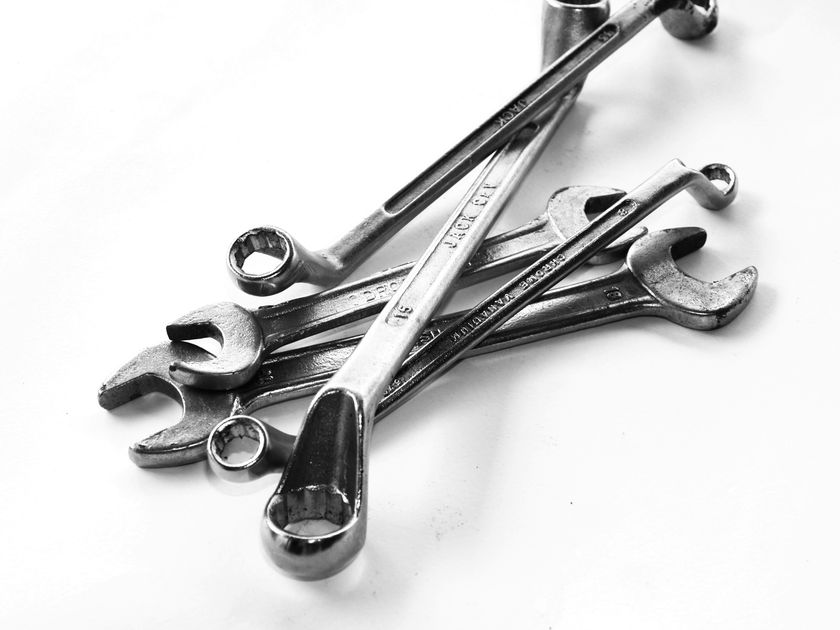
Hammers, screwdrivers, pliers, wrenches, spanners, and chisels form the foundation of any tools wholesale order. German brands Knipex and Gedore hold the premium end, particularly for oil-and-gas applications where torque accuracy and tool traceability matter. Stanley (part of Stanley Black+Decker) covers the professional mid-range. In the high-volume construction segment, buyers source from Taiwanese and Chinese manufacturers offering DIN or ANSI-certified product at significantly lower landed cost.
Power Tools
The GCC power tools market was valued at USD 1.46 billion in 2025 and is projected to grow at a 11.8% CAGR in value through 2035. Cordless power tool lines — drills, impact drivers, angle grinders, reciprocating saws — dominate procurement from the construction and maintenance segments. DeWalt and Makita lead authorised wholesale volumes in the UAE; Bosch Professional holds strong share in the institutional and industrial segments. Increasingly, Ingco and Total Tools are capturing the lower end of the contractor market with competitive landed pricing.
Cutting Tools and Abrasives
Cutting discs, grinding wheels, drill bits, hole saws, and saw blades move in high volume wherever construction and fabrication are active. Bosch and Metabo command premium shelf placement; Indian and Chinese manufacturers supply the bulk of commodity-grade cutting consumables. These products have high repurchase frequency, making them a reliable category for wholesale distributors serving contractor accounts.
Fasteners and Fixings
Bolts, nuts, washers, anchor bolts, screws, and rivets are among the highest-unit-volume SKUs in industrial hardware procurement. Chinese manufacturers in Zhejiang (particularly the Haiyan and Yongnian fastener clusters) dominate global supply. For UAE buyers, the practical question is not where fasteners come from but which grade standard applies: DIN, ISO, ASTM, or ASME/ANSI, depending on the project specification.
Measuring and Inspection Tools
Digital callipers, spirit levels, laser distance meters, torque wrenches, and multimeters are sourced by quality-controlled buyers in oil and gas, utilities, and fit-out. Japanese brands (Mitutoyo, Hioki) and German (Stabila, Fluke) dominate this niche. Most UAE distributors carry these as premium items with long-tail demand rather than high-volume turns.
Import Origins and Trade Routes
China is the dominant origin for UAE tool imports by volume. Zhejiang province — particularly the clusters around Yiwu, Wenzhou, and Hangzhou — produces the majority of hand tools, cutting tools, and fasteners exported globally. Power tool manufacturing is concentrated in Guangdong (Shenzhen, Dongguan) and Jiangsu. Sea freight from these regions to Jebel Ali typically takes 20–30 days. Factory MOQs from Chinese producers start at one full container (roughly 20–25 metric tons for hand tools), though consolidators in Yiwu and Guangzhou can source mixed-product containers at lower per-SKU volumes.
India is a significant and growing origin for hand tools, particularly from the Ludhiana and Jalandhar manufacturing belt in Punjab. Indian tools are generally positioned between Chinese commodity grade and European precision quality, and transit time to Jebel Ali is just 7–14 days. The UAE–India CEPA agreement has reduced or eliminated duties on a range of tool categories from 2022, making Indian-origin goods progressively more competitive on landed cost.
European origin — Germany for Knipex, Gedore, Metabo, and Fein; Sweden for Sandvik; Italy for Usag — remains the specification of choice for oil-and-gas, utilities, and defence procurement, where tool traceability and certification documentation are required alongside the hardware itself. Lead times from Europe run 3–5 weeks by sea, 5–7 days by air.
Japan (Makita, HiKoki/Hitachi) and South Korea (Shinhan, Park Tool) supply the professional power tool and precision hand tool segment, typically through their UAE-authorised distributors rather than direct import by end-buyers.
UAE Wholesale Hubs and Authorised Distributors
The UAE tools wholesale market is served by a tiered distribution structure: authorised principal distributors at the top, regional sub-distributors in the middle, and retail/trade counters at the bottom. For B2B buyers, engaging at the distributor or sub-distributor level gives access to pricing that is not available at trade counters, plus credit terms and project-supply agreements.
FKTools is one of the region's longest-established industrial tool distributors, operating for over 61 years with outlets across the UAE, Qatar, and Saudi Arabia. Its brand portfolio includes Gedore, DeWalt, Bosch, Makita, Knipex, Dormer, Fischer, and Norbar — covering a comprehensive range from hand tools to precision measuring equipment.
AABTools has been in the UAE market since 1960 and carries a similarly broad portfolio including Bosch and Makita. Its longevity is itself a quality indicator: established distributor relationships with principals are harder to replace than a low-price import.
SAFATCO Trading, founded in 1992, operates as a wholesale distributor for Makita, Bosch, DeWalt, and Stanley across all seven emirates, serving both trade and project accounts.
Beyond these established players, Sharjah Industrial Area (between Al Saja'a and Maysaloon) is home to dozens of hardware wholesalers serving the Northern Emirates construction and maintenance market. JAFZA's warehousing belt and Dubai's Al Quoz industrial district provide secondary sourcing points for Dubai-based buyers. For those procuring safety equipment alongside tools, many distributors in these zones stock both categories under one roof, simplifying procurement logistics.
B2B Procurement Checklist
Before committing to a wholesale tools order in the UAE, experienced procurement managers run through a consistent set of verification steps. Skipping any of these can result in non-compliant product, delayed customs clearance, or supplier disputes that are difficult to resolve across jurisdictions.
First, confirm the grade standard required by your project specification. Construction projects in the UAE typically reference DIN or ISO standards for hand tools; oil-and-gas projects often have additional OEM or operator-mandated certifications (ATEX for intrinsically safe tools, API for certain fittings). A tool that is perfectly adequate for general construction may be non-compliant on a petrochemical site.
Second, request a certificate of conformity or test report for the specific batch. This is not the same as a brand catalogue specification — it must relate to the actual production batch being supplied. For any tool that will be used in a safety-critical role, this document is non-negotiable.
Third, verify supplier credentials before making payment. For branded product, ask for the authorisation letter confirming the supplier is an official distributor of the brand in question. For grey-market product (genuine brand, purchased outside the authorised channel), warranty and after-sales support will be absent. Understanding this distinction matters for MRO buyers who need guaranteed parts availability. The process of verifying a UAE wholesale supplier starts with checking their trade licence against the activity they are claiming to conduct.
Fourth, confirm the tariff classification and applicable duty rate before your first shipment. Most hand tools (HS Chapter 82) and power tools (HS Chapter 84) attract 5% UAE customs duty on CIF value. However, specific sub-headings can differ, and errors in HS classification on the commercial invoice are a common cause of customs delays. Consult the UAE customs duty guide for B2B importers if you are new to the tariff schedule.
Fifth, align your payment and logistics terms with the supplier's risk profile. FOB origin is standard for direct China sourcing, shifting freight and insurance risk to the buyer at the point of loading. CIF to Jebel Ali is preferable for buyers without established freight relationships, as it bundles logistics into a single supplier-managed cost. For domestic UAE suppliers, 30/60-day credit terms are available from established distributors to vetted accounts.
Pricing, MOQs, and Lead Times
Pricing for wholesale tools in the UAE spans an enormous range. A basic carbon-steel screwdriver set from a Chinese manufacturer can land at under AED 10 per unit at volume; a Gedore torque wrench for oil-and-gas applications can exceed AED 2,000. The comparison is almost meaningless without specifying the application and the quality tier.
For branded professional power tools, UAE distributor pricing runs at a premium to European prices due to freight, duty, distributor margin, and VAT. A cordless drill/driver from a top-tier brand typically retails at 10–20% above its European list price at trade level. For high-volume project supply, negotiated trade pricing can narrow this gap significantly — frame agreements with distributors for annual volumes above AED 500,000 typically attract 8–15% off trade price, plus project-specific support.
For Chinese-origin commodity hand tools, the realistic landed cost at Jebel Ali (including freight, duty, and customs clearance) adds roughly 12–18% to FOB China price. A container-load MOQ from a Chinese factory would typically be 20–25 metric tonnes for hand tools — enough to fill a 20-foot or 40-foot container depending on density. Consolidators in Yiwu or Guangzhou can arrange mixed containers with lower per-product MOQs, at the cost of higher per-unit logistics expense.
For Indian-origin tools, transit times of 7–14 days and no duty disadvantage under CEPA make smaller, more frequent shipments practical. Indian suppliers are generally more flexible on MOQ — 100 to 500 pieces per SKU is a common working minimum — which suits distributors managing diverse stock profiles for electrical and hardware combined product portfolios.
Lead times should be negotiated explicitly, not assumed. A Chinese supplier quoting 25-day transit is quoting shipping time only; production lead time (if the item is not in stock) adds another 15–30 working days. Indian and UAE-based suppliers can often commit to ex-stock delivery within 3–7 working days for standard lines, making them the practical choice for urgent MRO restocking.
Source B2B Tools & Hardware Suppliers on IbaadU
IbaadU connects GCC procurement teams with wholesale suppliers of hand tools, power tools, fasteners, and industrial hardware. Submit a sourcing request and receive competitive quotes within 48 hours.
Find Tools Suppliers on IbaadU →Frequently Asked Questions
What is the minimum order quantity for wholesale tools in the UAE?
MOQs vary by product type. Premium branded power tools (Bosch, DeWalt, Makita) typically start at 10–50 units per SKU from authorised UAE distributors. Generic hand tools and fasteners from Chinese or Indian suppliers often require 100–500 pieces per line. For large MRO frame contracts, suppliers frequently set annual volume commitments rather than per-order minimums.
What import duty applies to hand tools and power tools imported into the UAE?
The UAE applies a standard 5% customs duty on the CIF value for most hand tools (HS Chapter 82) and power tools (HS Chapter 84). Tools of GCC origin generally benefit from zero intra-GCC tariffs under the Unified Customs Tariff. Goods stored in free zones such as JAFZA remain duty-deferred until they enter the UAE domestic market.
Which UAE free zone is best for tools and hardware trading?
JAFZA (Jebel Ali Free Zone) is the primary hub, offering direct Jebel Ali Port access with bonded warehousing and re-export flexibility. Hamriyah Free Zone in Sharjah offers lower warehousing costs for mid-volume traders supplying the Northern Emirates. Sharjah Industrial Area suits domestic-market distributors with no re-export requirement.
How long does it take to import tools from China or India to UAE?
Sea freight from China's Zhejiang tool clusters (Yiwu, Wenzhou, Hangzhou) takes 20–30 days to Jebel Ali. Shipments from India (Ludhiana, Jalandhar) arrive in 7–14 days. UAE customs clearance adds 1–3 working days. Factor in production lead time at origin — typically 15–30 working days for non-stock items.
Which tool brands are most trusted by GCC procurement managers?
For premium professional tools: Stanley Black+Decker, DeWalt, Bosch Professional, and Makita. For oil-and-gas precision tools: Knipex and Gedore. For budget-to-mid-range B2B buyers: Ingco and Total Tools have authorised UAE distribution. For abrasives and cutting discs: Bosch and Metabo hold dominant share.
How do I verify a UAE tools wholesale supplier is legitimate?
Request the supplier's UAE trade licence confirming wholesale trading of tools as a listed activity. For branded product, ask for the principal's authorisation letter (e.g. a Bosch or Makita distributorship certificate). Cross-check the company's JAFZA or DED registration number on the respective authority's public portal. Insist on a proforma invoice on company letterhead before payment. IbaadU's supplier network screens for these requirements.
Join IbaadU — The GCC B2B Marketplace
Whether you are a tools importer looking to reach GCC buyers or a procurement team needing a reliable sourcing pipeline, IbaadU's verified B2B platform connects both sides without middlemen.
Join IbaadU Today →