The $9.1B Gulf Medical Equipment Market — What the Numbers Actually Mean
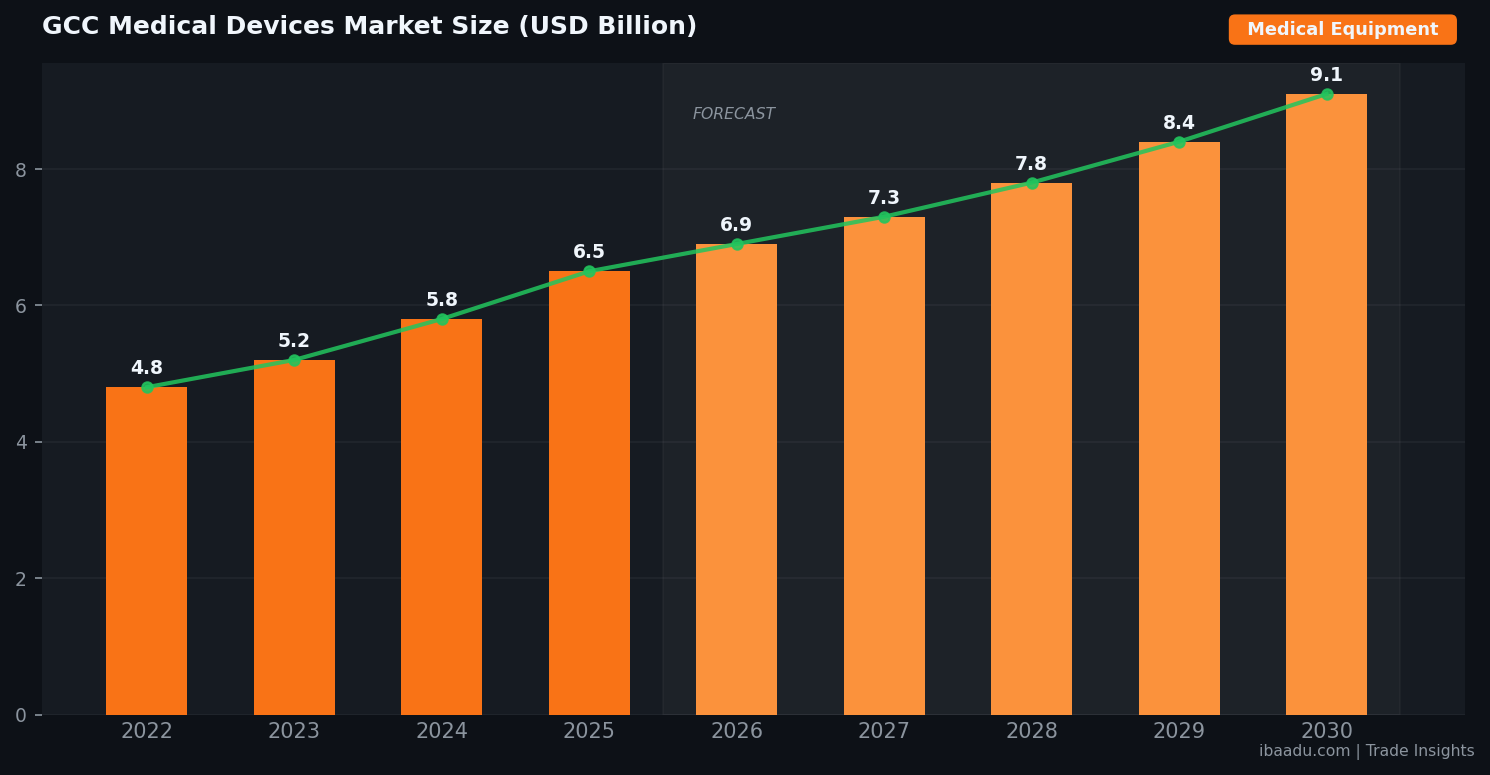
Saudi Arabia spent SAR 260 billion on health and social development in 2025 — a 12% increase on the prior year. That's not a budget line. That's a structural commitment to healthcare infrastructure that has taken the GCC medical devices market from a $4.8 billion segment in 2022 to a projected $9.1 billion by 2030, growing at roughly 5% CAGR even in a cautious global environment.
If you're a procurement manager in a Gulf hospital group, a supplier trying to crack the Saudi government tender market, or a distributor looking for the next equipment category to stock, those numbers have very direct implications for what you're buying, who you're sourcing it from, and what kind of qualification burden you're about to face.
The market is expanding fast — but it's not opening up in the way most outside suppliers assume. Government centralisation, In-Country Value mandates, and tightening regulatory registration requirements mean that the window for unregistered, unverified suppliers is closing. What's opening instead is a large, structured procurement ecosystem that rewards suppliers who invest early in the right certifications, partnerships, and regional relationships.
The GCC Medical Consumables market alone was valued at $459.75 million in 2025, with Saudi Arabia holding the largest share, followed by the UAE, Qatar, and Kuwait. This segment — which covers syringes, diagnostic kits, PPE, hospital disposables, and wound care products — is growing at 4.73% CAGR through 2032, according to MarkNtel Advisors. These are repeat-purchase, volume-sensitive product categories where supplier reliability and local logistics capability matter more than price alone.
The MENA medical devices market, which encompasses the broader region including Egypt, Jordan, and Levant markets, is projected to hit $14.37 billion by 2030, per Kinmed. The GCC bloc drives the bulk of this — and the UAE and Saudi Arabia together account for approximately 65-70% of regional procurement spend.
What's rarely discussed in market reports: the biggest procurement bottleneck right now isn't budget. It's supplier access. Hospital procurement teams across the Gulf are working through approved vendor lists that haven't been updated to reflect the new wave of quality Asian and European manufacturers entering the market. That gap — between available budget and qualified supplier access — is precisely where platforms like ibaadu.com are filling a genuine need.
How Saudi Arabia's NUPCO Controls SAR 25 Billion in Procurement
There's an institution that every medical equipment supplier targeting Saudi Arabia must understand before they approach a single hospital — and it's not a hospital. The National Unified Procurement Company, better known as NUPCO, controls access to over 400 public healthcare facilities across the Kingdom and manages annual procurement exceeding SAR 25 billion. If you're not registered with NUPCO, you're not selling to the Saudi public health sector. Full stop.
NUPCO was established to consolidate what was previously a fragmented, ministry-by-ministry procurement process that resulted in price inconsistency, quality variation, and supply chain inefficiency. It's now the central gatekeeper for pharmaceutical, medical device, and consumable procurement across Ministry of Health facilities, military hospitals, and the National Guard Health Affairs. The government tender market alone is valued at SAR 21 billion, making NUPCO one of the largest healthcare procurement organisations in the Middle East by volume.
In 2025, NUPCO secured three major financing agreements totalling SR 2.5 billion — roughly $666.6 million — with Banque Saudi Fransi, Abu Dhabi First Bank, and Tameed. The explicit purpose: strengthening supply chain financing for healthcare suppliers. Two new distribution centres scheduled to become operational in 2026 will reduce last-mile delivery times to under 24 hours for 85% of orders. For suppliers currently working with 72-hour delivery windows, that's a fundamental shift in logistics expectations.
The 2026 NUPCO tender cycle has introduced what industry insiders are calling a "local awakening" for pharmaceutical and medical device manufacturers. Tenders now include explicit localisation scoring criteria, meaning suppliers with Saudi manufacturing partnerships or licensed in-Kingdom operations score higher in the evaluation matrix. This isn't just regulatory compliance — it's a commercial differentiator. Suppliers who've invested in local partnerships are winning framework agreements that would previously have gone to purely import-based competitors.
For procurement teams on the buyer side, this matters because NUPCO's approved vendor lists are becoming the de facto quality benchmark for private hospital groups too. NMC Health, Dallah Hospital Group, and Saudi German Hospitals — all privately owned — increasingly reference NUPCO registration as a minimum qualification criterion for new supplier onboarding. Even if you're not buying through a government channel, your suppliers need to be in the NUPCO ecosystem.
The practical implication for Gulf B2B buyers: source medical equipment suppliers on ibaadu.com who already hold SFDA registration and NUPCO vendor credentials — it cuts your qualification timeline by weeks, not days.
UAE's Evolving Medical Procurement Landscape
The UAE operates a more decentralised procurement model than Saudi Arabia, but don't mistake decentralisation for simplicity. The Dubai Health Authority (DHA), Abu Dhabi Health Services Company (SEHA), and the Ministry of Health and Prevention (MOHAP) each maintain their own vendor registration systems, procurement guidelines, and product approval pathways. For a supplier entering the UAE market, that means three separate registration processes, three sets of documentation requirements, and three different tender calendars.
In 2025, the UAE introduced federal procurement guidelines with a significant addition: preferential scoring for medical products manufactured in-country or assembled locally. This In-Country Value (ICV) mechanism — already well-established in the oil and gas sector through ADNOC — is now making its way into healthcare procurement. Suppliers that can demonstrate UAE-based assembly, warehousing, or value-add processing are receiving scoring advantages in federal tender evaluations.
The UAE's medical tourism sector is also reshaping procurement dynamics in a way that isn't immediately obvious from the market size data. Dubai Healthcare City (DHCC) currently hosts over 150 medical facilities and is targeting 500 by 2030. Abu Dhabi's Cleveland Clinic, Mediclinic, and the expanding network of Aster DM Healthcare facilities are procuring at a standard that matches international private hospital benchmarks. The equipment specifications required for medical tourism-grade facilities — 3T MRI machines, robotic surgical systems, hybrid ORs — represent a procurement tier that has historically gone to a small group of established multinationals.
That's changing. Pure Health Holding's expanded partnership with Sinopharm Group, announced in 2025, is a clear signal that Gulf hospital groups are actively diversifying their supply base away from sole reliance on Western multinationals. The partnership focuses on syringes, diagnostic kits, PPE, and hospital disposables — high-volume, cost-sensitive categories where Chinese manufacturing quality has improved dramatically. Pure Health distributes across the UAE and GCC, meaning this partnership creates ripple effects through the entire regional supply chain.
For procurement professionals, the practical question is: how do you qualify alternative suppliers at scale without compromising on product standards? The answer isn't doing it manually one supplier at a time. It's using a B2B platform where supplier credentials — trade licences, product certifications, SFDA or CE markings — are already pre-screened. ibaadu.com's buyer portal is built specifically for this workflow.
🏥 Source medical equipment suppliers across the GCC on ibaadu.com. Browse suppliers by product category, country, and certification — no cold calls, no unverified contacts.
Find Suppliers on ibaadu →The Product Categories Where Gulf Demand is Surging
Not all medical equipment categories are growing equally. Understanding where procurement budgets are actually flowing — rather than where the market reports say they "should" be — is the difference between building a pipeline of real opportunities and wasting months on the wrong product set.
Diagnostic imaging is where the single largest ticket items are landing. Saudi Arabia's Vision 2030 healthcare infrastructure push includes 12 new medical cities and upgrades to 150 existing facilities, with image-guided operating rooms identified as a priority investment. CT scanners, MRI systems, digital X-ray, and point-of-care ultrasound are all in active procurement across both public and private sectors. The move toward 3T MRI across tertiary facilities is driving a significant replacement cycle — older 1.5T systems are being decommissioned, and procurement teams are running tenders for the upgrade equipment.
Minimally invasive surgical equipment is the fastest-growing category in procedure volume terms. Laparoscopic and robotic-assisted surgery adoption in the Gulf has accelerated sharply, with both Saudi and UAE health authorities using it as a medical tourism differentiator. The consumables tail on this category — trocars, staplers, energy devices — is high-volume, high-frequency, and contract-structured. Hospital groups that switch to a new laparoscopic platform are typically locked in to the accompanying consumable ecosystem for 3-5 years.
ICU and critical care equipment remains a sustained priority post-pandemic. Gulf health ministries made significant investments in ventilators and patient monitoring in 2020-2021, and those installations are now entering their maintenance and replacement cycle. Biomedical procurement teams are managing end-of-life planning for equipment that was emergency-purchased at a time when normal vendor qualification processes were bypassed. Many of those machines are now being replaced through proper tender processes — which means qualified vendors with SFDA registration and local service capability are well-positioned.
Consumables — wound care, IV sets, catheters, surgical drapes, and disposable gowns — remain the volume backbone of healthcare procurement. The GCC Medical Consumables market at $495.22 million in 2026 and growing to $635.29 million by 2032 represents a steady, predictable demand stream. For suppliers in this category, the differentiation isn't price — it's consistency of supply, shelf life management, and the ability to meet NUPCO's delivery SLAs.
Laboratory diagnostics is an emerging growth category that's often underestimated. UAE's national screening programmes, Saudi Arabia's Vision Realisation Programmes for chronic disease management, and the expansion of private diagnostics chains like Al Borg and G42 Healthcare's network are all generating substantial lab equipment and reagent procurement. Gulf-based medical equipment suppliers on ibaadu.com include vendors in this category with active stock.
What Suppliers Need to Know to Win Gulf Tenders
Here's the thing most medical equipment suppliers getting into the Gulf for the first time don't realise until they've lost their first tender: price competitiveness is table stakes. It doesn't win you anything on its own. What wins Gulf tenders — especially public sector ones — is documentation completeness, local support capability, and supply chain reliability. Get those three wrong and a higher-priced competitor with a local service engineer and a three-day delivery guarantee will beat you every time.
Regulatory registration is non-negotiable. The Saudi Food and Drug Authority (SFDA) requires product registration for all medical devices — Class I through Class III — before they can be sold into the Saudi market. The process typically takes 6-18 months depending on device classification. CE marking or FDA 510(k) clearance speeds the SFDA application significantly, but doesn't replace it. UAE's MOHAP maintains its own medical device registration system, and DHA requires separate facility licensing for suppliers operating in Dubai. Suppliers who come to Gulf tenders without pre-registration are essentially disqualified before the evaluation even starts.
Local service infrastructure is increasingly becoming a scored criterion, not just a preference. Hospital biomedical departments across the GCC have had too many experiences with equipment purchased from a regional distributor that disappeared post-sale. The 2026 NUPCO framework agreements explicitly require vendors to demonstrate UAE or KSA-based service capacity — either through a company-owned technical team or a certified local partner. For international manufacturers, this means appointing a credible regional distributor is a commercial prerequisite, not a nice-to-have.
Financial capacity matters more in the Gulf public sector than in most other markets. NUPCO's SAR 2.5 billion supply chain financing initiative was designed specifically to help SME suppliers meet the working capital demands of large government contracts. But suppliers still need to demonstrate the financial backing to fulfill framework agreement volumes, which can run into hundreds of millions of riyals across the contract period. Bank guarantees, letters of credit, and performance bonds are standard tender requirements.
Saudization and local content requirements are tightening. NUPCO's 2026 tender cycles are scoring suppliers on their investment in Saudi workforce development, local manufacturing partnerships, and in-Kingdom value creation. Suppliers who can demonstrate a local partner arrangement — even a warehouse operation or a training facility — are scoring ahead of purely import-based competitors. For Gulf procurement teams, this means the approved vendor list is also shifting: suppliers who've made this local investment are more likely to be sustainable long-term partners.
A Practical Sourcing Strategy for Gulf Procurement Teams
If you're running a procurement function at a Gulf hospital group, a medical supply distributor, or a health authority, the single biggest structural change in your operating environment right now is supplier diversification pressure. The concentration risk exposed during the 2020-2021 supply chain disruptions — single-source suppliers for critical consumables, import-dependent logistics for high-turnover disposables — hasn't fully been addressed by most procurement teams. It's still a vulnerability.
The smart approach being adopted by hospital groups like King Faisal Specialist Hospital, Aster DM Healthcare UAE, and Cleveland Clinic Abu Dhabi is a tiered supplier strategy: a primary approved supplier for each major category, a pre-qualified secondary supplier ready to activate within 48 hours, and an open sourcing channel for spot purchases and emergency procurement. Most procurement teams only have the first tier properly structured. Building out the second and third tiers is where the resilience actually comes from.
For the secondary supplier tier, the key is pre-qualification without the full onboarding overhead of your primary supplier. This is where a B2B platform with vendors pays for itself. Rather than conducting full qualification audits on 20 potential backup suppliers — consuming weeks of your team's time — you can identify 3-5 candidates on a platform like ibaadu.com, conduct a focused capability check, and have them approved-in-principle without activating a commercial relationship until it's needed.
Procurement calendar management is an underrated efficiency lever. Gulf public sector tender cycles are broadly predictable — NUPCO runs annual framework agreement tenders, DHA and MOHAP both have structured procurement windows. Building your sourcing outreach calendar around those cycles means you're qualifying suppliers 3-6 months before the tender deadline, not scrambling during the submission window. Shortlisting suppliers early through platforms like ibaadu.com can reduce that pre-tender scramble.
On price benchmarking: the Gulf medical equipment market has significantly more pricing opacity than mature Western markets. Without a reference point, procurement teams overpay or under-specify. Regular market intelligence — talking to multiple qualified suppliers on the same product category simultaneously — is the most reliable way to build a realistic price benchmark. An open B2B marketplace gives you that competitive visibility without requiring multiple individual relationship development cycles.
The bottom line for Gulf procurement teams in 2026: you're operating in a market with $9.1 billion in addressable equipment demand by 2030, a government procurement structure that's becoming more structured and more demanding simultaneously, and a supplier landscape that's diversifying faster than most approved vendor lists are being updated. The procurement teams that build diverse, pre-qualified supplier pipelines now — rather than relying on the same three distributors they've used for the last decade — are the ones who'll perform when the next supply chain disruption hits.
To connect with medical equipment suppliers across the UAE, Saudi Arabia, Qatar, and the wider GCC, create a free buyer account on ibaadu.com or reach us directly via WhatsApp at +97148322427.
Frequently Asked Questions
How do I register as a supplier with NUPCO in Saudi Arabia?
Suppliers must register on NUPCO's online vendor portal, submit SFDA product registration certificates, and meet Saudization and local content requirements where applicable. Framework agreements are awarded through open tender cycles, typically announced on the Etimad government procurement portal.
What is the fastest-growing medical equipment category in the GCC in 2026?
Diagnostic imaging equipment (MRI, CT, ultrasound) and minimally invasive surgical devices are growing fastest, driven by Saudi Arabia's 12 new medical city projects and UAE's medical tourism expansion. ICU and critical care equipment is also surging as pandemic-era purchases reach their replacement cycle.
Do GCC hospitals prefer local or imported medical equipment?
Both, but the balance is shifting. UAE introduced in-country value (ICV) scoring in federal procurement guidelines in 2025. Saudi Arabia's NUPCO actively promotes local manufacturing through its localisation programme. That said, high-tech diagnostics and specialised surgical systems are still predominantly sourced internationally.
How can a medical equipment supplier find buyers in the Gulf?
The most effective channels are B2B trade platforms like ibaadu.com that connect regional buyers directly with suppliers, participation in Arab Health and DUPHAT exhibitions, and direct engagement through procurement departments of major hospital groups like NMC, Mediclinic, and government health authorities.
The Gulf Medical Equipment Market Doesn't Wait for Slow Movers
SAR 260 billion in Saudi health spending. UAE's ambition to become the region's medical tourism capital. NUPCO managing frameworks that cover 400+ facilities. These aren't aspirational numbers — they're 2026 procurement realities that suppliers and buyers across the Gulf are navigating right now.
The suppliers winning in this environment aren't necessarily the biggest or the cheapest. They're the ones who invested in SFDA registration before the tender deadline, built local service capacity before the evaluation, and found qualified regional buyers before the relationship had to happen under pressure. And the procurement teams performing best aren't those with the largest budgets — they're the ones who built diversified, pre-qualified supplier pipelines before the next supply disruption proved why it mattered.
If you're a medical equipment supplier looking to expand into GCC markets, or a procurement professional needing to qualify new vendors fast, ibaadu.com is the B2B trade marketplace built for exactly this market. Browse suppliers by product category and country, or list your company to reach Gulf buyers directly.
📲 WhatsApp us directly: +97148322427 — our team connects buyers and suppliers across the GCC's healthcare procurement market.