The Scale of the Opportunity: $61B and Climbing
When UAE Customs processed USD 60.98 billion in electrical and electronics imports in 2024, it wasn't news to anyone who works on the buy-side in the Gulf. It was confirmation of what procurement professionals have felt for years: this region doesn't just use technology — it consumes it at a pace that strains global supply chains and reshapes global sourcing strategies.
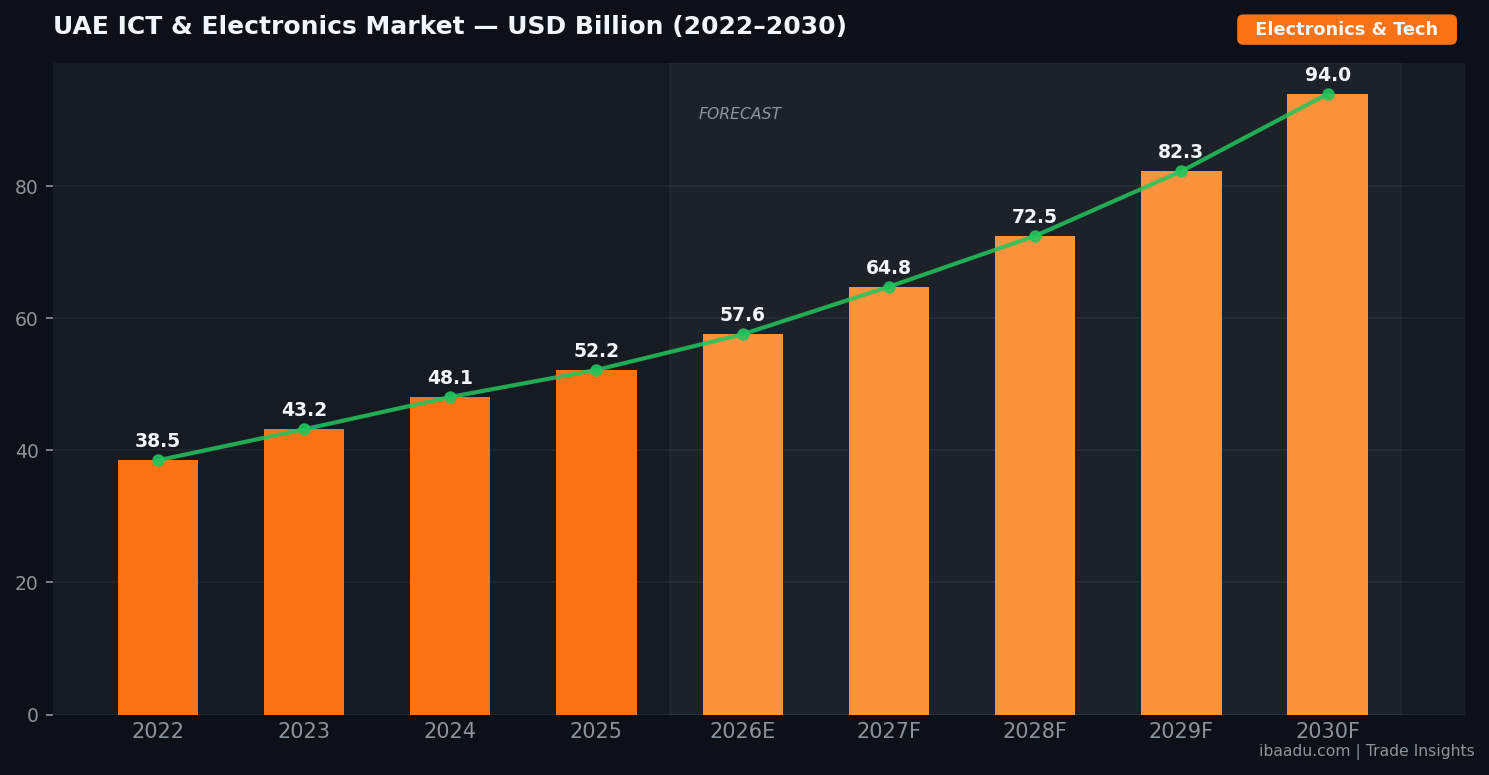
That figure — $61 billion in a single year, from a country of roughly 10 million residents — puts the UAE on a short list of the world's most electronics-intensive procurement markets. Singapore and South Korea are the only comparable examples of small, wealthy trade hubs that absorb this kind of hardware volume. The difference is that the UAE's appetite isn't plateauing. The ICT market alone is projected to expand from USD 52.2 billion in 2025 to USD 57.6 billion in 2026, with Mordor Intelligence forecasting it will reach USD 94 billion by 2031. That's a compound annual growth rate of 12.6% — almost three times the global electronics market average.
What's driving this? Three structural forces that every Gulf procurement professional needs to understand.
First, the megaproject pipeline. Saudi Arabia's giga-projects — NEOM, The Line, Diriyah, Qiddiya — are absorbing billions in electronics, controls, networking gear, and smart building systems. NEOM's procurement machine has already awarded contracts for 5G-Advanced networks, AI data centres, and autonomous mobility systems that collectively represent hundreds of millions in hardware commitments. Procurement Magazine estimates NEOM's technology procurement could top $50 billion over the full project lifecycle — a figure that would exceed the annual GDP of most MENA countries.
Second, the industrial transformation agenda. Both the UAE's Operation 300bn industrial strategy and Saudi Vision 2030 are pushing manufacturers to digitise at scale. Factory automation, industrial IoT, predictive maintenance systems, energy monitoring equipment — this wave of investment is hitting procurement desks across the Gulf simultaneously. KIZAD and SEZAD tenants alone have collectively signalled billions in automation-related purchasing for 2026 and 2027.
Third — and this is the figure that surprises even experienced procurement professionals — the re-export engine. A significant portion of UAE electronics imports are re-exported, primarily to Africa, South Asia, and broader MENA. Dubai functions as a global distribution hub, meaning Gulf-based trading companies and distributors are procuring at a scale that reflects not just domestic demand but regional demand aggregated through Jebel Ali and Dubai Customs. If you're selling electronics anywhere in MENA, your product very likely touches a UAE-based distributor at some point in the chain.
This convergence of megaproject spend, industrial transformation, and regional distribution function has created a procurement market that's genuinely unlike anywhere else. The question isn't whether the volumes are there. It's whether your procurement strategy is built to capture them.
What Gulf Procurement Teams Are Actually Buying
The aggregate import figure tells you about scale. It doesn't tell you where the action is category by category. Here's what procurement managers are actually requisitioning in 2026 — broken down by where the volume and the growth both align.
Networking and Telecommunications Infrastructure remains the single largest category by value. Enterprises in the UAE and Saudi Arabia are midway through large-scale WiFi 6E and private 5G rollouts. Data centres — the UAE now hosts over 60 live facilities with dozens more under construction — continuously cycle in new switching, routing, and cabling. Huawei, Ericsson, Nokia, and Cisco dominate enterprise-scale projects, but the long tail of networking components — patch panels, managed switches, access points, structured cabling, SFP modules — represents a procurement opportunity that's wide open for regional distributors and specialist suppliers. If you've been tracking ibaadu's trade insights, you'll know this segment has been consistently flagged as undersupplied at the distributor tier.
Industrial Automation and Control Systems is the fastest-growing category in percentage terms. Procurement teams at manufacturing facilities across KIZAD, ICAD, and Jebel Ali Free Zone are sourcing PLCs, SCADA systems, HMI panels, variable frequency drives, and industrial sensors at a pace that routinely outstrips regional distributor inventory. Siemens, Schneider Electric, Rockwell Automation, and ABB all report record Gulf order books, but lead times on certain components remain stretched at 20–30 weeks. This is exactly the kind of supply gap where verified B2B suppliers on ibaadu can serve urgent cross-border needs efficiently.
Data Centre Hardware has shifted from a purely enterprise category to a government-priority one. Following HUMAIN — PIF's AI infrastructure venture — announcing a landmark partnership with Cisco to build Saudi Arabia's AI backbone, the downstream procurement cascade includes servers, GPUs, cooling systems, uninterruptible power supplies, and specialised rack infrastructure. Don't think this is limited to hyperscalers. Every government ministry in UAE and Saudi Arabia is under pressure to migrate to cloud infrastructure, generating procurement demand for edge computing hardware and on-premise server refresh cycles at the tier-2 and tier-3 buyer level.
Energy Electronics is quietly becoming one of the largest sub-categories in the Gulf. The UAE's target of 44% clean energy by 2050, and Saudi Arabia's 14GW renewable procurement programme currently underway, require massive volumes of inverters, solar monitoring systems, grid management electronics, and EV charging infrastructure. These aren't consumer electronics — they're industrial-grade components with long qualification cycles, requiring suppliers with Gulf-specific certifications and documented track records. Procurement teams sourcing this equipment consistently report that finding qualified regional suppliers is harder than it should be — a gap that platforms like those serving Gulf renewable procurement are specifically designed to address.
Security and Surveillance Systems cover everything from smart cameras and access control to integrated command-centre systems for smart cities. Abu Dhabi's Safe City initiative, Dubai's Smart City programme, and Riyadh's Vision 2030 urban transformation collectively represent procurement volumes running into hundreds of millions annually. Hikvision, Dahua, Genetec, and Axis dominate at the enterprise level, but integrators and system installers have a continuous need for components, peripherals, and support hardware from verified regional suppliers.
What's striking about all five of these categories is that they share the same procurement problem: qualified, verified supplier options in the Gulf region are fewer than the market size warrants. That's not a supply constraint — it's a discovery constraint. The suppliers exist. The buyers exist. The B2B infrastructure to connect them at scale is what's been missing.
Sourcing Challenges Reshaping the Gulf Electronics Supply Chain
It's not all straightforward growth. The Gulf electronics procurement landscape in 2026 comes with a set of structural challenges that are genuinely reshaping how experienced buyers operate — and creating competitive advantages for procurement teams that adapt early.
The Hormuz Premium. Marine insurance premiums for vessels transiting the Strait of Hormuz rose 300–500% during the disruptions of 2024–2025. For electronics shipments — high-value, relatively low-weight cargo that's typically priced FOB or CIF — this translated directly into landed cost increases that procurement teams hadn't budgeted for. Most Gulf buyers now hold 60–90 days of strategic safety stock on critical electronics lines instead of the 30-day buffers that were standard before 2023. This ties up working capital and increases warehousing costs, but the risk of a stockout on industrial controls or networking gear during a Hormuz disruption is operationally catastrophic for a manufacturing client.
Country-of-Origin Scrutiny. As US export controls on advanced semiconductors have tightened, Gulf procurement teams are navigating a more complex compliance landscape. Electronics sourced from certain suppliers — particularly AI accelerators, advanced networking chips, and specific industrial computing components — require more documentation than they did three years ago. Procurement departments without experienced trade compliance staff are getting caught out. The practical implication: authorised regional distributors who understand GCC import compliance are commanding a premium over grey-market alternatives, and buyers are paying it.
Counterfeit and Substandard Components. The Gulf market — particularly for components transiting through informal channels — has a documented counterfeit electronics problem. Fake Cisco transceivers, clone Schneider Electric circuit breakers, non-compliant solar inverters. Every procurement professional who's been in the Gulf long enough has a story. The response from serious buyers has been to consolidate around authorised distributor networks and platforms with supplier verification — precisely the model that ibaadu.com is built around for B2B trade in the region.
Lead Time Volatility. Semiconductor shortages may have eased from their 2021–2023 peak, but lead times on specialised industrial components remain unpredictable. Programmable Logic Controllers, power semiconductors, and certain networking ASICs can still run at 20–40 weeks from tier-one OEMs. Gulf procurement teams that relied on just-in-time have largely moved to hybrid models: JIT for commodity electronics, safety-stock buffers for business-critical components. This has increased total procurement value but spread it across more suppliers and more SKUs — which increases the supplier qualification burden considerably.
Localisation Pressure. Both the UAE and Saudi Arabia have introduced policies incentivising local manufacturing and preferring locally-produced goods in government procurement. The Emirates Development Bank's AED 30 billion fund specifically targets electronics and electrical equipment as a priority manufacturing sector. This doesn't mean imported electronics are disappearing — the volumes are far too large for domestic manufacturing to absorb in the near term — but it does mean procurement teams working on government projects need to factor in local content requirements that add complexity to sourcing decisions.
The procurement teams handling these challenges best are the ones who've invested in supplier diversification and verification infrastructure before they needed it — not after a stockout or a counterfeit incident forced the issue.
NEOM and Smart Cities: The Next Electronics Procurement Wave
If you want to understand where Gulf electronics procurement is heading over the next five years, you can't look at today's demand — you need to look at what NEOM and the broader GCC smart city agenda have already committed to buy.
NEOM's active procurement commitments as of early 2026 include a 300MW data centre project, a bespoke 5G-Advanced private network covering all NEOM territories, an AI-powered traffic and logistics management platform, and a fully autonomous port at Sindalah. Each of these requires a procurement cascade of electronics that runs from headline contracts down to components, accessories, and field installation hardware. Procurement Magazine has documented NEOM's shift toward a vertically integrated procurement approach — not just buying from global OEMs, but actively qualifying regional and specialist suppliers to reduce lead times and build local supply chain resilience.
HUMAIN, PIF's AI infrastructure venture, has signed partnerships with Cisco, NVIDIA, and AMD to build what Saudi officials describe as the kingdom's "sovereign AI backbone." What does this mean for procurement professionals? It means the next wave of Gulf electronics demand isn't consumer-grade. It's enterprise and industrial-grade hardware at a scale requiring procurement teams with genuine technical depth — teams that can evaluate server thermal envelope specifications, cooling efficiency PUE metrics, and network latency requirements, not just unit price.
Beyond Saudi Arabia, smart city electronics procurement is active across all six GCC states. Abu Dhabi's Safe City phase two, Dubai's smart parking and congestion management expansion, Qatar's post-World Cup smart infrastructure reuse projects, and Oman's Duqm smart port expansion all represent live procurement pipelines. SEZAD — the authority managing Duqm Special Economic Zone — has flagged automation and digital infrastructure as priority categories for 2026 supplier engagement.
What types of electronics are smart city projects actually buying? The list is broader than most procurement professionals realise. Edge computing nodes, environmental sensors, smart lighting controllers, video analytics servers, building management system (BMS) integration hardware, EV charging infrastructure, smart grid meters, and the unglamorous but essential cabling and power distribution infrastructure that holds it all together. Many of these categories are sourced through small and mid-sized specialist suppliers rather than the Cisco and Schneider Electrics of the world — which is exactly where B2B platforms serving Gulf procurement become genuinely useful for procurement managers trying to qualify non-tier-one vendors efficiently.
The ten-year electronics procurement pipeline implied by NEOM, Vision 2030 industrial projects, UAE gigaprojects, and the GCC smart city agenda collectively is larger than the total electronics market of most mid-sized economies. Procurement teams and suppliers who build the relationships and qualification infrastructure now are positioned to capture a market that most global companies are still underestimating.
Connect directly with qualified Gulf-region suppliers for networking equipment, industrial controls, data centre hardware, and energy electronics. No middlemen. No sourcing agents.
Browse Verified Suppliers →How to Qualify Electronics Suppliers for Gulf Contracts
Let's be practical. You've got a procurement requirement — say, 50 managed switches for a new manufacturing facility in Abu Dhabi, or a shipment of industrial UPS units for a process plant in Jubail. How do you actually qualify a supplier for a Gulf contract in 2026? The framework has evolved significantly over the last three years.
Technical Standards Compliance First. Gulf electronics procurement increasingly requires adherence to ESMA (Emirates Authority for Standardisation and Metrology) technical regulations for products sold in the UAE, and SASO (Saudi Standards, Metrology and Quality Organisation) certification for the Saudi market. For certain categories — electrical safety, EMC compliance, hazardous area equipment — there's zero flexibility. Suppliers who can't provide ESMA or SASO certificates upfront are immediately disqualified from serious tender processes. If you're sourcing internationally, your supplier needs to have done this homework already, before the RFQ stage.
Authorised Distributor Verification. Given the counterfeit problem in regional electronics channels, most serious Gulf buyers now require proof of authorised distributor status for branded components. An authorised Cisco, Schneider, or Siemens distributor carries a product traceability guarantee that grey-market channels can't match. The price premium for authorised distributors is typically 8–15% — a small cost relative to the operational and reputational exposure of a counterfeit component failure in a live industrial environment.
Local After-Sales Support Capability. This is where many international suppliers fall down in Gulf procurement evaluations. The Gulf market is not forgiving of vendors who can't provide on-the-ground technical support. For industrial controls and data centre hardware, buyers expect a local service engineer available within 4–8 hours of a critical fault being raised. Suppliers without a UAE or KSA-based support operation are systematically disadvantaged in enterprise and government procurement processes, regardless of how competitive their pricing is.
Trade Finance and Payment Terms Alignment. Gulf procurement for electronics above a certain value — typically AED 500,000 or SAR 500,000 — increasingly involves documentary credit or LC-backed transactions, particularly for international suppliers. Knowing whether your supplier can handle LC terms, and whether they have the financial standing to accept 30–60 day payment terms on large orders, is a pre-qualification question that should be answered before issuing an RFQ. Platforms like ibaadu that display verified supplier profiles significantly reduce the due diligence burden.
Minimum Order Quantities and Regional Logistics Experience. Electronics suppliers in Asia — particularly from China, South Korea, and Taiwan — often have MOQ requirements that don't align with Gulf procurement volumes. A mid-sized Gulf buyer sourcing 200 units of a specific industrial sensor doesn't always have the leverage to get competitive pricing from a tier-one Asian OEM. Regional distributors who hold Gulf-market inventory and understand local customs procedures solve this problem directly — and they're exactly the type of supplier well-represented on B2B platforms designed for Gulf trade.
Can't afford to get the qualification wrong? Think of it this way: a single counterfeit component failure or compliance-related customs hold can cost more than an entire year's savings from sourcing off the authorised distributor network. The math on thorough upfront qualification is unambiguous.
Finding Verified Suppliers on ibaadu.com
The market opportunity in Gulf electronics procurement is not ambiguous. The challenge — for both buyers and suppliers — has always been the discovery and verification problem. How does a procurement manager in Riyadh or Abu Dhabi, under time pressure to close a requisition, confidently connect with a supplier they've never dealt with before? And how does a supplier — whether they're a Shenzhen electronics manufacturer, a Turkish industrial controls distributor, or a Jordanian IT reseller — find and qualify Gulf buyers who are actively in the market for what they sell?
This is the gap that ibaadu.com was built to close. It's a dedicated B2B trade marketplace built specifically for the Middle East and GCC — not a global platform where Gulf buyers are an afterthought, but a platform where Gulf trade is the primary use case. Supplier profiles are verified. Categories are structured around the actual procurement categories that Gulf buyers use: electronics, industrial equipment, construction materials, medical devices, chemicals, and logistics.
For procurement teams, the practical advantages are material. Search for suppliers by category, country of origin, and certification. Request quotations directly. Review supplier history and credentials without going through a sourcing agent who takes a margin for the privilege of an introduction. Do all of this knowing that suppliers on the platform have been vetted — not just scraped from a public directory.
For suppliers, the opportunity is equally clear. If you're an electronics manufacturer or distributor looking to develop Gulf business — whether in UAE, Saudi Arabia, Qatar, Oman, Kuwait, or Bahrain — the buyers are on ibaadu. Companies investing in smart city infrastructure, industrial automation, data centre expansion, and energy transition are actively reviewing supplier options today. The question isn't whether the demand exists. It's whether your company is visible to the buyers placing the requisitions.
Given the scale of what's coming — USD 94 billion in ICT spend by 2031 in the UAE alone, NEOM's technology procurement pipeline, the Gulf-wide industrial transformation over the next decade — the procurement teams and suppliers who build regional relationships now are positioning themselves to capture a category that most global companies are still underestimating.
Start the conversation today. Visit ibaadu.com to browse verified suppliers and buyers, or reach our team directly on WhatsApp: +971 58 597 8602.
Frequently Asked Questions
How large is the UAE electronics procurement market in 2026?
The UAE ICT market reached USD 57.6 billion in 2026, up from USD 52.2 billion in 2025. Total electronics and electrical equipment imports exceeded USD 60.98 billion in 2024, making the UAE one of the largest technology import markets in the MENA region. Growth is driven by data centre expansion, industrial automation, smart city infrastructure, and the UAE's role as a regional re-export hub.
Which electronics categories are Gulf procurement teams prioritising in 2026?
The top categories by value are networking and telecommunications equipment, industrial automation controls (PLCs, SCADA, VFDs), data centre hardware, renewable energy electronics, and smart building and security systems. AI infrastructure procurement — servers, GPUs, edge computing — is growing fastest following Saudi Arabia's HUMAIN programme and the UAE's data centre expansion.
Where can B2B buyers find verified electronics suppliers for the Gulf market?
ibaadu.com is a dedicated B2B trade marketplace for the Middle East and GCC, connecting procurement teams directly with verified regional and international suppliers of electronics, industrial equipment, and technology products. Suppliers are vetted and searchable by category, country of origin, and certification status.
How are Hormuz disruptions affecting electronics procurement costs in the Gulf?
Marine insurance premiums for vessels transiting the Strait of Hormuz rose 300–500% during 2024–2025 disruptions, directly increasing landed costs for electronics imports. Most Gulf procurement teams have responded by extending safety-stock buffers from 30 to 60–90 days, qualifying alternative sourcing routes through Oman ports, and increasing direct air freight for high-value, time-critical components.