In this article
The UAE's industrial landscape crossed a historic milestone this week at the Make It in the Emirates (MIITE) 2026 forum in Abu Dhabi. The government announced AED180 billion — approximately $49 billion — in new industrial procurement opportunities, targeting the localisation of over 5,000 product categories that the country currently imports. For B2B buyers, manufacturers, and procurement managers across the Gulf Cooperation Council, the announcement represents one of the most significant sourcing policy shifts in the region's industrial history.
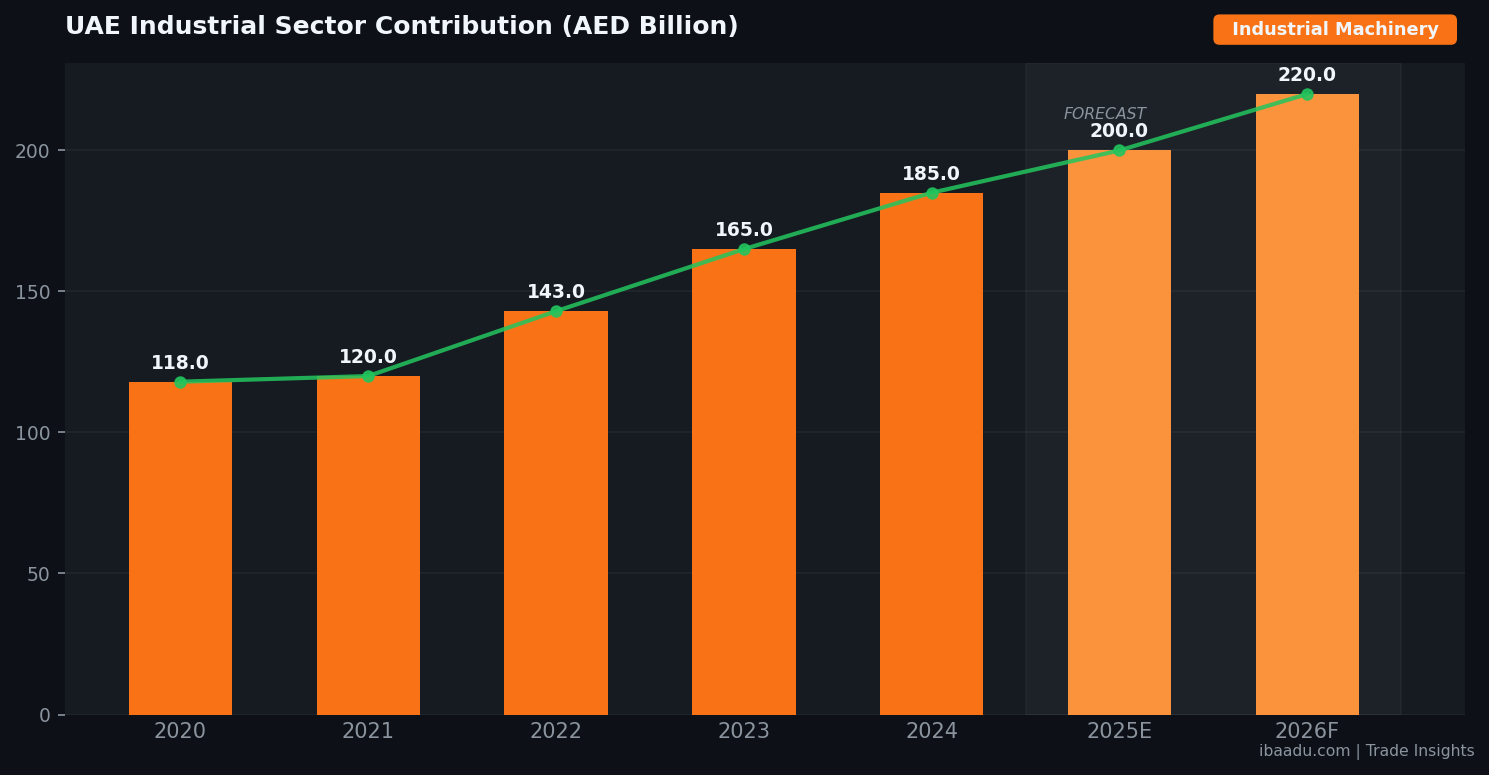
Coming just days after the UAE's industrial sector contribution surpassed AED200 billion — a 70% increase since 2021 — the MIITE 2026 initiative signals a decisive pivot from oil-dependent growth toward a diversified, locally anchored manufacturing base. Whether you are a GCC-based supplier seeking to enter UAE government supply chains, or a procurement director looking to align your sourcing strategy with the country's new ICV (In-Country Value) mandates, understanding the structure of this initiative is essential for competitive positioning in the months ahead.
MIITE 2026: Inside the UAE's AED180 Billion Industrial Pledge
The Make It in the Emirates forum has evolved from a regional trade showcase into the most influential industrial policy platform in the Arab world. The 2026 edition, held from May 4 to 7 at ADNEC Abu Dhabi, attracted more than 1,100 exhibitors across 12 industrial sectors and drew procurement delegations from across Africa, Asia, and Europe in addition to the Gulf. This year's centrepiece announcement — delivered by Dr. Sultan Al Jaber, UAE Minister of Industry and Advanced Technology — raised the national industrial procurement commitment from AED168 billion to AED180 billion, effective over the next decade.
Critically, the pledge is not a standalone incentive package but an integrated programme that binds together government procurement budgets, sovereign wealth fund supply chains, and national company purchasing policies under a single industrial sovereignty framework. The AED1 billion National Industrial Resilience Fund, also announced at MIITE 2026, will provide co-financing for manufacturers localising products in priority categories, covering feasibility studies, pilot production runs, and technology transfer costs. This fund is specifically designed to de-risk new entrants who are willing to invest in UAE-based production but face high initial capital requirements.
The UAE's industrial exports have simultaneously reached a record AED262 billion, confirming that localisation is not merely import-substitution but is generating genuine export competitiveness. For procurement professionals, this dual dynamic — rising domestic supply capability alongside export-oriented production — means that UAE-made products are increasingly meeting international quality standards, making local sourcing a viable upgrade rather than a compromise.
Sectors and Products in Focus: What Buyers Are Sourcing
The AED180 billion procurement drive is deliberately structured around twelve industrial verticals where the UAE judges it has the greatest strategic vulnerability to supply chain disruption. These include pharmaceutical and medical devices manufacturing, food processing and packaging, advanced construction materials, industrial chemicals and petrochemicals, precision engineering and metalwork, defence-adjacent industrial components, renewable energy equipment, electronics assembly, automotive aftermarket components, water treatment equipment, logistics automation systems, and agrochemicals. Buyers in government entities, national companies, and large private sector firms will be guided — and in many cases required — to prioritise domestically manufactured alternatives when local production meets technical specifications.
For B2B procurement managers, the practical implication is a systematic audit of existing supplier bases against ICV compliance. Products sourced from overseas that have a locally manufactured equivalent will face increasingly tight justification thresholds under new federal procurement rules. This is not merely regulatory pressure: the UAE government has made clear that large infrastructure programmes — including those tied to COP28 legacy projects, the expansion of Abu Dhabi's industrial zones, and Dubai's Logistics Corridor — will be conditioned on demonstrable local content ratios.
On the supply side, Sharjah's industrial investment at MIITE 2026 captured particular attention, with the emirate reporting AED3.51 billion in industrial investment over five years and surpassing AED1.6 billion in new industrial projects in 2025 alone. This decentralised industrial growth — across Abu Dhabi, Dubai, Sharjah, Ras Al Khaimah, and Fujairah free zones — means procurement teams have a genuinely expanding roster of domestic suppliers to evaluate, particularly in plastics, metals processing, food production, and light manufacturing.
Source Verified B2B Suppliers on ibaadu
Connect directly with Industrial Machinery & Manufacturing suppliers and manufacturers across the GCC. No middlemen.
Browse Suppliers →ICV Compliance and the New Mandatory Framework for Suppliers
The single most operationally significant change announced at MIITE 2026 is the expansion of the National In-Country Value (ICV) programme from a voluntary scoring mechanism into a mandatory compliance framework for all federal government entities and national companies. Previously, ICV certification improved a supplier's bid score in competitive tenders but was not an absolute prerequisite for contract award. Under the new mandatory framework, suppliers without valid ICV certification will be ineligible for procurement contracts above specified thresholds — a structural shift that procurement managers must factor into their supplier qualification processes immediately.
ICV certification is awarded by approved third-party certifiers and measures a company's economic contribution to the UAE across five dimensions: cost of locally manufactured products, expatriate and national workforce composition, investments in fixed assets, R&D and innovation expenditure, and procurement spend directed to other UAE-registered businesses. The certification is valid for one year and must be renewed annually with audited financial data. Companies that invest in expanding their UAE manufacturing footprint, hiring local talent, or procuring sub-components from UAE-registered suppliers will see their ICV scores improve — and their competitive position in government tenders strengthen proportionately.
For GCC-based suppliers who export into the UAE market but have no local presence, the new mandatory framework introduces a meaningful barrier to entry for government-linked contracts. The strategic response — increasingly adopted by Saudi, Qatari, and Omani manufacturers — is to establish a UAE-registered trading, assembly, or light manufacturing entity, even at modest scale, to qualify for ICV certification and access the broadening procurement pipeline. The AED1 billion Resilience Fund's co-financing provisions may be accessible to such entities where the product category aligns with priority localisation targets.
How GCC Manufacturers Can Win UAE Industrial Contracts in 2026
Translating the headline AED180 billion procurement figure into actual contract wins requires a disciplined approach that most GCC manufacturers have not yet operationalised. The first step is category mapping: systematically identifying which of the 5,000+ targeted product categories your company manufactures or can manufacture, then cross-referencing those against the specific federal entities and national companies — ADNOC, EDGE Group, Emirates Steel, Mubadala, Abu Dhabi Ports, and others — that have formalised procurement commitments under the MIITE framework. Each entity publishes an ICV-aligned procurement plan, and these plans are the most actionable entry points for new supplier engagement.
Second, quality certification alignment is non-negotiable. UAE government procurement specifications typically reference ISO 9001 quality management systems, UAE.S technical standards for construction and materials, and sector-specific certifications such as SFDA approval equivalencies for food and pharma products. Manufacturers who have invested in GCC Standardisation Organisation (GSO) accreditation are particularly well-positioned, as GSO standards are recognised across all six GCC states and reduce the certification overhead for suppliers targeting multiple markets simultaneously.
Third, digital visibility on B2B procurement platforms has become a critical differentiator. UAE government procurement officers and private sector sourcing teams routinely use online supplier directories to identify qualified vendors before formal tender processes begin. Being listed with verified company credentials, product catalogues, and ICV certification status on platforms like ibaadu positions suppliers for early-stage engagement — often before a tender is even published. The ability to respond quickly to an RFI with a comprehensive company profile and technical specification sheet frequently determines which suppliers receive a formal RFQ invitation.
Finally, relationship-building within UAE free zone industrial communities — particularly in KIZAD (Abu Dhabi), Jebel Ali (Dubai), and SAIF Zone (Sharjah) — remains highly valuable. Procurement networks in the UAE operate on personal referral and reputation to a greater extent than in Western markets. Participating in MIITE, the Dubai International Project Management Forum, and sector-specific industry associations accelerates relationship development in ways that digital marketing alone cannot replicate. GCC manufacturers who combine online platform visibility with in-person engagement at UAE industrial events will consistently outperform those who rely on either channel in isolation.
Frequently Asked Questions
What is the UAE's MIITE 2026 industrial procurement initiative?
MIITE 2026 (Make It in the Emirates) is the UAE's flagship industrial forum held in Abu Dhabi from May 4–7, 2026. At the event, the UAE government announced AED180 billion ($49 billion) in new industrial procurement opportunities aimed at localising over 5,000 products across sectors critical to economic, food, and healthcare security.
Which sectors are targeted by the AED180 billion procurement drive?
The procurement opportunities span twelve industrial sectors including petrochemicals, pharmaceuticals, food processing, advanced manufacturing, defence industries, renewable energy equipment, medical devices, construction materials, automotive components, electronics, packaging, and logistics equipment. The initiative prioritises import-substitution products that strengthen the UAE's supply chain resilience.
How can foreign manufacturers qualify for UAE In-Country Value (ICV) programme benefits?
Foreign manufacturers can qualify for ICV benefits by establishing a local manufacturing or assembly presence in the UAE, sourcing a defined percentage of raw materials or sub-components from UAE-based suppliers, employing UAE nationals, and investing in local R&D or training. The ICV programme is now mandatory across all federal government entities and national companies, making ICV certification a prerequisite for winning public procurement contracts.
Where can GCC suppliers and buyers connect to access these industrial procurement opportunities?
B2B platforms like ibaadu.com allow GCC-based manufacturers, suppliers, and buyers to connect directly without intermediaries. Suppliers can list their capabilities and certifications, while procurement managers can search verified vendors across all major industrial categories. Registering on ibaadu is free and puts your business in front of active buyers across the UAE, Saudi Arabia, Qatar, and beyond.
Conclusion
The UAE's AED180 billion industrial procurement announcement at MIITE 2026 is the most consequential supply chain policy shift in the Gulf in a decade. For GCC manufacturers, it opens a structured, government-backed demand pipeline across twelve industrial sectors — but only for those who proactively align their operations with ICV certification requirements, UAE technical standards, and the new mandatory procurement framework. The window for first-mover advantage is narrow: procurement plans are being finalised now, preferred supplier lists are being compiled, and the companies that establish their UAE credentials in the next six to twelve months will hold a durable competitive advantage over late entrants. Whether you are a manufacturer in Riyadh, Muscat, Doha, or Cairo, the time to engage with UAE industrial procurement is not after the next MIITE — it is today.