What Is the UAE's $49 Billion Industrial Procurement Push in 2026?
At MIITE 2026, the UAE unlocked AED180 billion ($49 billion) in industrial offtake commitments, opening long-term procurement contracts to manufacturers and suppliers who can deliver on UAE soil or into UAE supply chains. ADNOC's AED200bn contract pipeline and accelerating localisation policy make this the most immediate sourcing opportunity for Gulf B2B suppliers this year.
What Actually Happened at MIITE 2026 — and Why It Matters Now
Between May 4 and 7 in Abu Dhabi, the UAE industrial sector didn't just hold a conference. It issued something closer to a standing purchase order — AED180 billion ($49 billion) in long-term GCC procurement strategies commitments, open to manufacturers and industrial suppliers who can deliver product on UAE soil or into UAE supply chains. If you're in B2B industrial trade in the Gulf and you haven't mapped your business against these opportunities yet, that's the only urgent item on your to-do list right now.
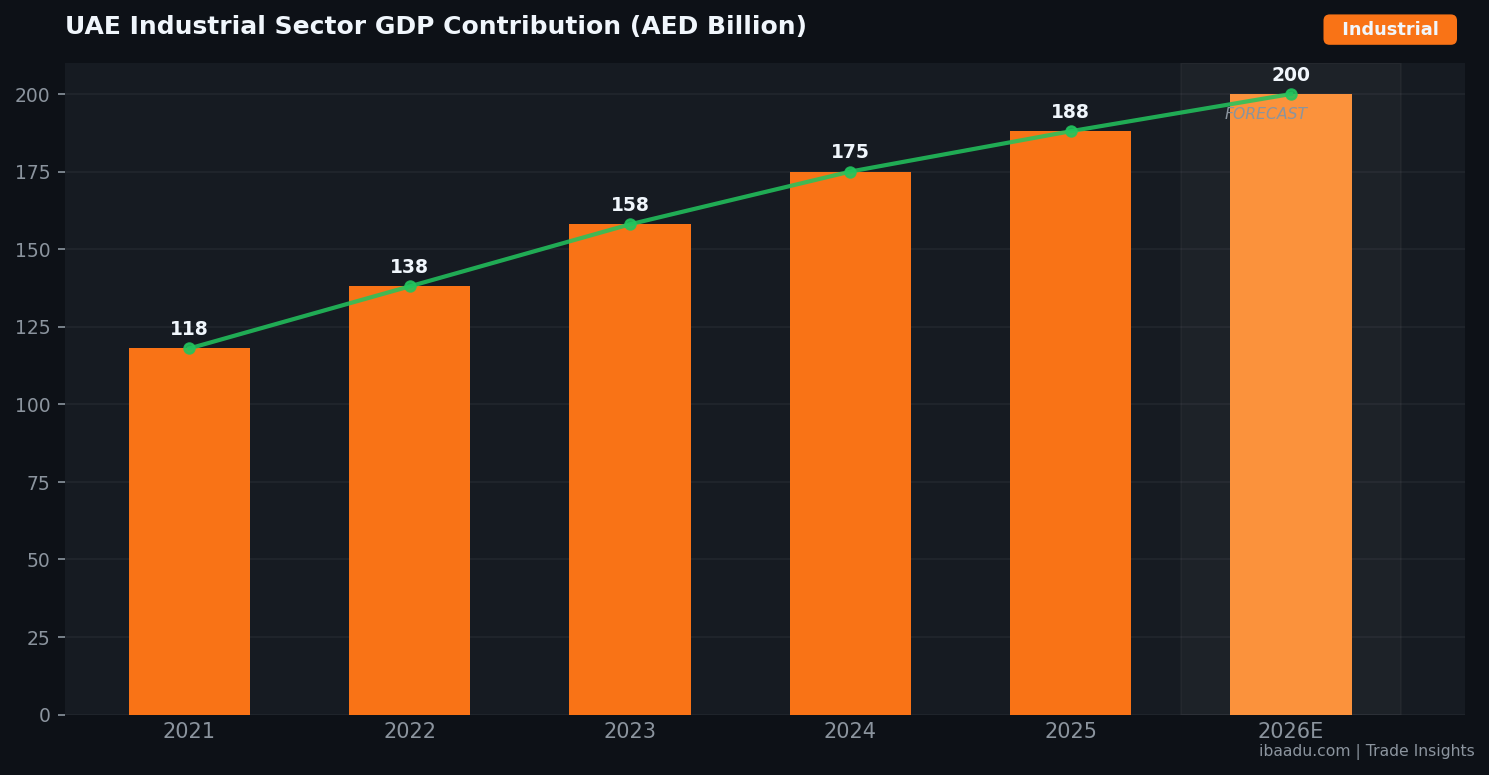
MIITE — Make It In The Emirates — is now in its fifth year, and the numbers tell the story of a government that's serious about industrial transformation. The UAE's industrial sector contribution to GDP has climbed to AED200 billion, up 70% since 2021. Industrial exports hit AED262 billion — including AED92 billion in what the government classifies as advanced industrial exports, meaning high-value-added manufactured goods rather than raw commodity shipments. These are not projections. These are the baseline figures against which the $49 billion opportunity is layered.
What's different about MIITE 2026 compared to prior editions isn't the ambition — the UAE has been announcing industrial localisation targets for years. What's different is the regional context forcing acceleration. The conflict with Iran has made import dependence a strategic liability, not just a cost management concern. When procurement teams at major UAE entities tell me they're losing sleep over supply chain continuity, they're not speaking hypothetically. They're describing real conversations happening in real procurement departments right now. The $49 billion commitment is partly a market-opening statement and partly a strategic hedge.
Dr Sultan bin Ahmed Al Jaber, UAE Minister of Industry and Advanced Technology, framed it plainly at the event: the initiative offers manufacturers the chance to localise more than 5,000 products across sectors critical to economic, food, and healthcare security. Read that list carefully — economic, food, healthcare. Those three categories cover a significant chunk of what B2B trade marketplaces like ibaadu's industrial machinery suppliers serve every day.
The Sectors Unlocked: Where $49 Billion is Flowing
Not all of the $49 billion is equally accessible to every supplier type. Let me break down where the money is actually moving, because the sectoral distribution matters enormously if you're trying to position a product or a business for capture.
Chemicals & Petrochemicals: The Biggest Single Commitment
Ta'ziz — the joint venture between ADNOC and ADQ — dropped the single largest announcement at MIITE 2026: AED105 billion in long-term agreements covering offtake, feedstock, and sales contracts with terms running from five to twenty-five years. To put that in context, AED105 billion is roughly $28.6 billion — more than half the headline $49 billion figure, concentrated in a single industrial chemicals zone.
The Ta'ziz industrial zone at Al Ruwais in western Abu Dhabi is designed to produce 4.7 million tonnes per annum of chemicals when it reaches full capacity in 2028. This includes a 1 million tonne per annum ammonia plant, a 1.8 million tonne methanol plant (fed by a 25-year natural gas supply deal with ADNOC Gas), and 1.9 million tonnes of marketable products from an integrated PVC complex. The companies already locked into long-term supply and offtake agreements include Proman, Emirates Global Aluminium, Mitsubishi Corporation, Mitsui & Co., Sanmar Group, and Tricon. Procurement teams in chemicals, plastics, and related industrial sectors need to understand this as a structural shift — not a project, but a new baseline for GCC chemical supply chains.
For chemical and petrochemical suppliers on ibaadu, this means significant buyer volume emerging from the UAE's own industrial base over the 2026–2028 build phase, followed by long-term demand from the manufacturing operations themselves.
Advanced Manufacturing & Industrial Machinery
The $270 million National Industrial Resilience Fund deserves more attention than it's getting. Announced alongside the headline $49 billion figure, the fund is specifically designed to substitute up to $24.5 billion in industrial imports — approximately $820 million per year — by supporting domestic manufacturers who can replace foreign-sourced industrial products. Four thousand jobs is the employment target, but the procurement implication is more significant: the government is effectively guaranteeing off-take for qualified domestic manufacturers across a broad range of industrial machinery and components categories.
Saudi Arabia's parallel trajectory reinforces the regional picture. The Kingdom's machinery and equipment market has crossed USD 1.71 billion in annual value, with construction machinery accounting for over 45% of market share — driven by NEOM, Diriyah, Roshn, Amaala, and the broader Vision 2030 giga-project pipeline. By 2023, more than 30% of new machinery installations in Saudi factories involved automated or AI-driven technology, according to Ken Research. That figure is almost certainly higher now. The procurement teams buying this equipment are increasingly looking for regional suppliers who can offer faster delivery, local parts support, and in-country service capability — exactly the profile that industrial machinery suppliers on ibaadu's Saudi Arabia listings are positioned to fulfil.
Healthcare & Food Security: The Two Silent Sectors
The conflict factor has driven two sectors up the localisation priority list in ways that weren't visible eighteen months ago. Healthcare manufacturing — specifically pharmaceutical and medical device production — is now a declared national security concern. The GCC currently imports roughly 80% of its pharmaceutical supply. The UAE's LIFEPharma has committed $200 million to domestic medicines production, and that figure represents just one company's response to a broader structural policy push. Procurement managers in healthcare supply chains who've spent years sourcing from European or Asian manufacturers are now fielding calls from UAE-based production facilities that simply didn't exist three years ago.
Food security follows a similar pattern. Restaurant operators in the UAE are actively increasing their share of locally grown and UAE-produced ingredients. That sounds like a retail trend, but its procurement implications run deep into packaging, cold chain logistics, food processing equipment, and agricultural machinery — all categories where verified B2B supplier networks matter enormously.
🔑 Procurement insight: The $49bn figure is a decade-long commitment, but the bulk of capital expenditure in chemicals, advanced manufacturing, and healthcare will concentrate in 2026–2028 — the active build phase. Suppliers who establish qualification relationships now will have the advantage.
How B2B Suppliers Can Access These Procurement Contracts
Here's the part that most trade coverage misses: the $49 billion in commitments doesn't come with a single procurement portal, a unified application form, or a consolidated tender database. It flows through a combination of direct negotiations with state-owned entities, free zone authority procurement programmes, in-country value (ICV) certification requirements, and — increasingly — digital B2B trade networks that connect verified suppliers with active procurement teams.
Let me walk through the four primary access routes, because understanding which one applies to your business determines how you should be positioning right now.
Route 1: In-Country Value (ICV) Certification
If you're selling to ADNOC, DEWA, KIZAD-anchored entities, or any major UAE state-owned enterprise, ICV certification isn't optional — it's the gating criterion. The UAE's ICV programme scores suppliers on the proportion of value they add domestically: local employment, UAE-based manufacturing, technology transfer, and Emirati ownership. A supplier with an ICV score of 70 or above is effectively preferred over a foreign competitor even when the foreign offer is cheaper. Several international machinery and chemicals suppliers I've spoken to in the past year have restructured their Gulf operations specifically to increase their ICV scores — establishing UAE assembly operations, hiring local engineers, and partnering with UAE-based distributors. That's not incidental; it's a direct commercial response to where the procurement money is going.
Route 2: Free Zone Anchor Relationships
KIZAD (Khalifa Industrial Zone Abu Dhabi) and SEZAD (Special Economic Zone Al Dhafra) are the two free zone authorities most directly connected to the Ta'ziz and ADNOC supply chains. Both have active supplier registration programmes. The practical insight that procurement professionals often miss: free zone anchor relationships work best when you approach them before the tender is issued, not after. The procurement teams at KIZAD-anchored industrial facilities have supplier preference lists that are built during the project development phase — twelve to eighteen months before formal procurement processes begin. Showing up at the tender stage means you're already behind the preferred supplier list.
Route 3: CEPA Networks
The UAE's Comprehensive Economic Partnership Agreements — now covering 25+ countries with a target of AED1 trillion in non-oil trade — create preferential access for suppliers from signatory nations. If your business is based in India, Indonesia, Israel, Turkey, or one of the other UAE CEPA procurement opportunities partner countries, your products may already qualify for reduced or zero tariffs into UAE industrial procurement. The 25% industrial export growth target announced at MIITE 2026 is partly predicated on these CEPA relationships generating reciprocal supplier access. Understanding which CEPA applies to your product category is a straightforward tariff-schedule exercise that can translate into a meaningful competitive advantage.
Route 4: Digital B2B Trade Networks
The fourth route is the one that's grown most rapidly over the past two years, and it's where platforms like ibaadu.com sit. As the scale of UAE and Saudi industrial procurement has grown, so has the inefficiency of purely relationship-driven supplier discovery. Procurement managers at mid-tier manufacturers, free zone businesses, and trading companies simply don't have the bandwidth to run full RFQ and bulk sourcing guide processes for every category purchase. They're increasingly relying on verified B2B directories and marketplace platforms to build their approved supplier lists. If your business isn't listed on a regional B2B platform with credentials and product specifications, you're invisible to a growing segment of Gulf procurement teams — not because they don't want to find you, but because they're not using the old methods to look.
Source Industrial Suppliers on ibaadu.com
Browse supplier listings across industrial machinery, chemicals, energy, and manufacturing sectors. Connect directly via WhatsApp or post a free procurement request.
Browse Industrial Suppliers →ADNOC's AED200bn Contract Pipeline: The Immediate Opportunity
While MIITE 2026 focused on the decade-long $49 billion localisation commitment, ADNOC made a separate announcement that procurement professionals need to track with equal urgency: AED200 billion in contracts to be awarded over the next two years. That's a two-year timeline, not ten. It's upstream and downstream expansion, and it covers the full spectrum of oil and gas equipment, industrial services, and advanced manufacturing that feeds into ADNOC's operational base.
To understand what this means in practice, consider that ADNOC's existing local content programme has already generated USD 24.5 billion in ICV contributions from its supply chain. The new AED200 billion pipeline is roughly three times the scale of what's been spent annually on local content in recent years. Even if only 40% of that contract value flows to non-oil industrial categories — equipment, materials, services, logistics — it represents $22 billion in procurement activity over 24 months across categories where regional suppliers can compete.
The specific categories where Gulf-based suppliers have the highest probability of contract capture include: industrial valves and pipe fittings, safety equipment and PPE, electrical and instrumentation components, maintenance equipment, specialist chemicals, and industrial packaging. These aren't glamorous categories, but they're the categories where ADNOC's procurement team is actively looking to reduce import dependency — and where an ICV-certified regional supplier has a structural advantage over a European or Asian competitor.
For procurement teams on the buying side, the implication is different but equally clear. If you're sourcing any of these categories for a project that feeds into the ADNOC supply chain — directly or through a tier-two supplier — you need verified regional sources now. The lead times on imported industrial equipment have extended, shipping costs through the Strait of Hormuz remain elevated, and your downstream customer is increasingly asking for in-country value evidence in the supply chain. Platforms like ibaadu's Gulf chemicals and industrials listings exist precisely to solve this supplier discovery problem at speed.
Ta'ziz's Methanol and Ammonia: Downstream Demand Creation
One dynamic that doesn't get enough coverage in trade analysis: the Ta'ziz chemicals complex, once operational, doesn't just produce chemicals — it creates industrial demand. A 1.8 million tonne methanol plant needs catalyst, maintenance equipment, specialist piping, control systems, laboratory instruments, and a continuous supply of maintenance chemicals. A PVC complex needs chlorine, salt, heat exchangers, and reactor maintenance services. The $28.6 billion in Ta'ziz offtake agreements locks in the revenue side. The operational procurement — the ongoing purchasing that happens after the facility is commissioned — isn't in that figure. That's additional, recurring B2B spend that will flow through regional supplier networks for decades.
The Iran War Factor: Why Industrial Localisation Just Got Urgent
It would be incomplete to discuss the UAE's industrial procurement push in 2026 without addressing the regional context directly. The conflict with Iran has fundamentally altered the risk calculus for supply chain planners across the Gulf. This isn't about speculation or political commentary — it's a straightforward operational reality that's reshaping where procurement teams source and how they structure contracts.
The Strait of Hormuz carries roughly 20% of global oil trade and a significant share of Middle East import traffic. Elevated tensions have increased insurance premiums, extended transit times, and — for a period in early 2026 — created genuine uncertainty about vessel routing. Fujairah and Khor Fakkan, on the UAE's east coast, have absorbed much of the rerouted freight, but the episode demonstrated something procurement managers already knew intellectually but hadn't had to act on operationally: import-dependent supply chains are fragile in ways that become very visible very fast during regional stress events.
AGBI reporting from May 2026 notes that conflict is actively accelerating the shift to local production in the UAE. Restaurant operators are increasing UAE-grown ingredients. Manufacturers are moving warehousing on-shore. Free zone operators are seeing increased interest from companies that want to establish local manufacturing or assembly capabilities as a supply chain hedge, not just a tax efficiency play. The Omani-Saudi border trade data tells the same story from a different angle: conflict pushes bilateral trade to record levels as regional supply chains self-organise around new realities.
For B2B suppliers evaluating whether to establish Gulf region operations or increase regional inventory, the risk calculus has shifted. The cost of establishing a UAE or Saudi presence — whether a free zone entity, a distribution hub, or a local manufacturing joint venture — looks different when you compare it against the cost of supply chain disruption during a period of regional instability. Procurement teams who've lived through the past eighteen months are having those conversations with their supply chain partners right now.
🔑 What experienced Gulf procurement professionals know: Regional sourcing isn't always cheaper on day one. It wins on reliability, lead time, and supply chain resilience — and those advantages compound during periods of regional stress. The smart procurement teams have been building regional supplier bases for two years. The rest are catching up now.
What Gulf Procurement Teams Should Do This Quarter
Fourteen years of working with Gulf procurement teams has taught me that the gap between "we know this opportunity exists" and "we've captured our share of it" is almost always an execution problem, not an information problem. The $49 billion opportunity at MIITE 2026 has been covered in Gulf Business, MEED, CIPS Arabia bulletins, and regional trade media. The question isn't whether you've heard about it. The question is what you're doing differently because of it.
Here's the practical guidance for both sides of the transaction — suppliers and buyers — for the next three months.
For Industrial Suppliers Seeking Gulf Market Access
First: get your ICV documentation in order. If you don't know your current ICV score or what it would be if you established a UAE entity, find out. The ICV calculation methodology is publicly available from the UAE's Ministry of Industry, and it's worth the afternoon it takes to understand it. Second: identify the three or four specific product categories in the MIITE 5,000-product localisation list where your manufacturing capability is a direct match. Don't try to capture the whole list — find where your technical specificity gives you an advantage. Third: get listed on regional B2B trade platforms with complete product specifications, certifications, and company credentials. Procurement teams are doing digital supplier discovery before they make any calls.
For Procurement Teams Building Gulf Supplier Bases
Start with a spend analysis by import origin country. If more than 40% of your industrial procurement value is coming from Asian or European suppliers for categories that exist in the UAE or Saudi regional supply base, you have both a compliance exposure (ICV requirements) and a supply chain risk. Run a structured mapping exercise against ibaadu's bulk procurement categories and KIZAD's supplier database. You don't need to shift everything immediately — you need to know where regional alternatives exist, qualify two or three options, and have them on your approved supplier list before the next regional disruption creates procurement urgency. That urgency will come.
The Timing Window That Won't Stay Open
Here's the dynamic that procurement professionals with long Gulf experience understand and newer market entrants miss: the 2026–2028 window is when the UAE's industrial build phase is most active. Construction and commissioning phases generate procurement volumes that don't recur. A chemicals complex being built creates procurement demand for construction equipment, piping systems, electrical systems, safety equipment, and specialist services that won't be purchased again once the facility is operational. If you want to be part of the Ta'ziz supply chain or the ADNOC expansion pipeline, the time to establish relationships and qualify as a supplier is while the build is underway — not after commissioning, when procurement has shifted to operational maintenance cycles and the approved vendor lists are already locked.
Does your business have the regional presence, the verified credentials, and the digital visibility to be found by Gulf procurement teams running their supplier discovery right now? If not, that's a solvable problem — and solving it in Q2 2026 is better than solving it in Q4, when the early-phase procurement decisions have already been made.
Frequently Asked Questions
What is the UAE's MIITE 2026 industrial procurement initiative?
MIITE (Make It In The Emirates) 2026 is the UAE's fifth annual industrial localisation summit, held in Abu Dhabi from May 4–7, 2026. It unveiled AED180 billion ($49 billion) in industrial procurement opportunities over the next decade, targeting localisation of 5,000+ products across industries critical to economic, food, and healthcare security.
Which sectors benefit most from UAE industrial localisation in 2026?
Chemicals and petrochemicals lead with AED105 billion in Ta'ziz deal commitments. Advanced manufacturing, healthcare products, food security supply chains, and industrial machinery follow. ADNOC's separate AED200 billion two-year contract pipeline covers oil and gas equipment and industrial services across the full upstream and downstream value chain.
How can B2B suppliers access UAE industrial procurement contracts?
Suppliers access these contracts through four primary routes: ICV (In-Country Value) certification for state-owned enterprise procurement, free zone anchor relationships with KIZAD and SEZAD, CEPA trade agreements providing preferential tariff access, and digital B2B trade networks like ibaadu.com where supplier listings connect with active Gulf procurement teams.
What is ADNOC's local content procurement target for 2026?
ADNOC announced AED200 billion ($54.4 billion) in contracts to be awarded over the next two years for upstream and downstream expansion, with strong preference for ICV-certified suppliers and UAE-manufactured products. This is in addition to the broader MIITE 2026 industrial procurement framework.
The Bottom Line for Gulf B2B Trade
The $49 billion figure from MIITE 2026 isn't a projection or a policy aspiration — it's a contractual commitment backed by the procurement budgets of ADNOC, ADQ, Ta'ziz, and the full network of UAE state-linked industrial entities. Against the backdrop of a 70% growth in industrial GDP contribution since 2021, a $270 million resilience fund targeting $24.5 billion in import substitution, and a regional context that has made supply chain localisation a strategic imperative rather than a cost optimisation exercise, the direction of travel is clear.
For B2B suppliers who want to participate — whether you're a regional manufacturer, a global company building Gulf presence, or a trading entity connecting international products to Gulf buyers — the sourcing ecosystem is shifting in your favour. The demand is there, the procurement budgets are committed, and the government infrastructure to support local industrial activity is expanding. What's needed now is the supplier visibility and buyer-supplier connectivity that converts policy commitment into actual commercial transactions.
That's where ibaadu.com comes in. As a B2B trade marketplace built specifically for the Middle East, ibaadu connects industrial suppliers with procurement teams across the UAE, Saudi Arabia, Qatar, Oman, Kuwait, and Bahrain. Whether you're a vendor looking to get in front of Gulf buyers or a procurement team building a regional supplier base, start the conversation today.
Ready to Connect with Gulf Industrial Buyers and Suppliers?
Browse vendors, post a procurement request, or talk directly to our trade team via WhatsApp.