UAE's $49 Billion MIITE Procurement Wave: What Every Gulf Supplier Needs to Know

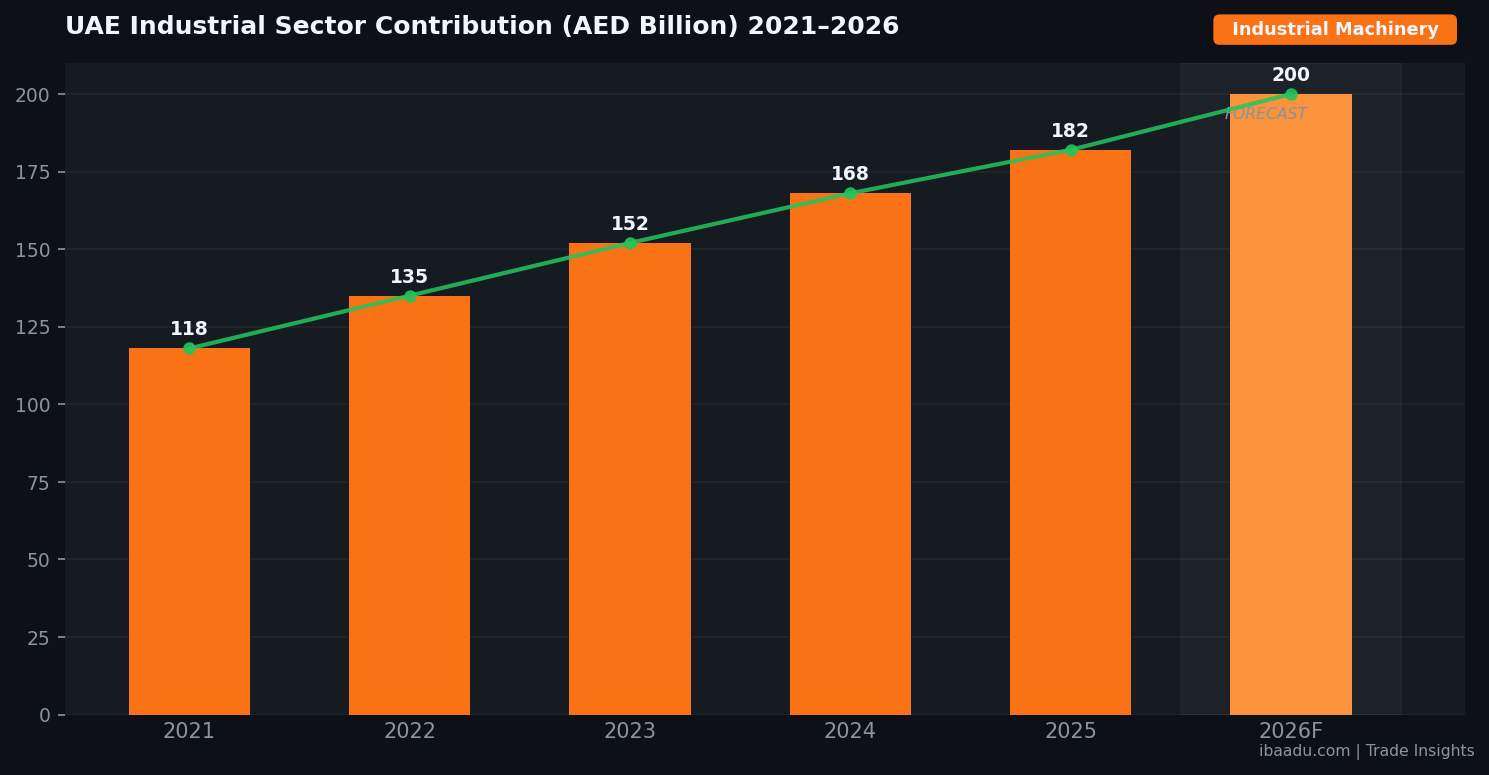
UAE industrial sector contribution grew 70% from AED 118B in 2021 to a projected AED 200B in 2026. Source: MIITE 2026 / UAE Ministry of Industry & Advanced Technology.
In This Article
- MIITE 2026: What Actually Happened at ADNEC Abu Dhabi
- ADNOC's AED 200 Billion Pipeline and the Local+ Mandate
- The Five Sectors Where Procurement Spending Moves First
- The Supplier Playbook: How to Position for MIITE-Linked Contracts
- Buyer Intelligence: Sourcing Verified Suppliers Without the Middlemen
- The Regional Ripple Effect: Saudi, Qatar, and Oman Align
The week of 4 May 2026 was the clearest signal yet that the UAE's industrial ambitions aren't just policy slogans. AED 180 billion in industrial procurement commitments — that's roughly $49 billion — landed on the table at the fifth edition of Make it in the Emirates (MIITE 2026) in Abu Dhabi. Not projections. Not aspirations. Firm offtake agreements and procurement frameworks signed in front of 1,245 exhibitors spanning 88,000 square metres of ADNEC's halls.
If you're a procurement manager at a Gulf construction company sourcing lifting equipment, or a regional machinery distributor trying to get onto ADNOC's supplier list, the MIITE 2026 announcements change your landscape. Not eventually. Now.
Here's what actually happened, what it means for B2B supply chains across the region, and how to position your organisation to benefit.
MIITE 2026: What Actually Happened at ADNEC Abu Dhabi
MIITE — Make it in the Emirates — started in 2021 as a relatively modest matchmaking exercise between government buyers and local manufacturers. Five editions in, it's become the Gulf's most consequential B2B procurement event. The 2026 forum brought together government entities, ADNOC group companies, major EPC contractors, and international machinery manufacturers for what can only be described as a procurement blitz.
Dr. Sultan Al Jaber, who chairs both ADNOC and the UAE Ministry of Industry and Advanced Technology, opened the forum with a declaration that the UAE's industrial sector contribution had hit AED 200 billion — a 70% increase since the programme launched. Industrial exports reached a record AED 262 billion. These aren't vanity metrics; they translate directly into the volume of procurement activity flowing through the market.
The forum ran three core threads: government offtake commitments, ADNOC's supply chain programmes, and a product localisation drive targeting more than 5,000 individual SKUs across strategic sectors. Each thread creates a different procurement opportunity. Government commitments open long-term supply contracts. ADNOC programmes create preferred supplier pathways. Product localisation creates gaps where manufacturers with the right capabilities can step in as import substitutes.
One figure that catches even experienced procurement professionals off guard: the UAE's industrial exports have grown to AED 262 billion, making the country a net exporter of manufactured goods in several categories. Ten years ago, that would have seemed unlikely. It changes how regional buyers think about UAE-origin certificates and local content compliance — and it changes what's possible for the suppliers who've invested in local manufacturing capability.
For procurement teams sourcing industrial equipment, the practical takeaway is this: if you're not already reviewing MIITE-linked frameworks as part of your supplier qualification process, you're operating on incomplete market intelligence. The procurement landscape in the UAE just got significantly more structured — and that creates both opportunities and risks for buyers who rely on informal supplier networks.
ADNOC's AED 200 Billion Pipeline and the Local+ Mandate
ADNOC's "Make it with ADNOC" forum, running alongside MIITE, announced over AED 200 billion in planned procurement and projects across the next two years. For context, that's the equivalent of the entire Saudi machinery and equipment market — doubled — flowing through a single entity's supply chain in 24 months.
The programme that deserves closest attention is Local+. It's not a PR initiative. Local+ connects engineering, procurement, construction, and services (EPCS) contractors with 70 qualified Emirati manufacturers, and mandates that those contractors prioritise locally manufactured products across every ADNOC project. That mandate has commercial teeth: contractors who don't demonstrate local content compliance in procurement reporting face scoring penalties in bid evaluations.
What does this mean for a procurement manager sourcing pumping equipment or industrial valves for a KIZAD project? It means your approved vendor list needs to reflect the Local+ framework, or your team will be creating compliance risk for your EPC contractor. Conversely, if you're a distributor for a European machinery brand, your proposition needs to address how you support local content compliance — whether through local assembly, service centres, or certified UAE-origin components.
The ADNOC EPCS contractor network includes names like Petrofac, Technip Energies, and a range of Emirati EPC firms. All of them are now under pressure to show local procurement receipts. That pressure cascades down to their tier-2 and tier-3 suppliers — which is where most regional B2B machinery distributors operate. The procurement opportunity isn't only at the ADNOC gate. It's in the supply chain of every contractor who feeds into ADNOC projects.
Understanding which of the 70 Local+ manufacturers cover which product categories — and which gaps remain — is where the real commercial intelligence sits. Browse industrial vendors on ibaadu.com to cross-reference your procurement requirements against regional manufacturing capability.
The Five Sectors Where Procurement Spending Moves First
Not all of the AED 180 billion lands at the same time. Based on MIITE 2026 announcements and the project pipelines feeding ADNOC and government programmes, five sectors will see the fastest procurement velocity over the next 12–18 months.
1. Industrial Machinery and Capital Equipment
The broadest and highest-value category. With KIZAD hosting over 600 companies across 410 km² of industrial land, procurement demand spans CNC machining equipment, hydraulic presses, conveyor systems, and precision fabrication tooling. Saudi Arabia's machinery and equipment market is simultaneously growing — valued at USD 1.71 billion and tracking toward USD 2.2 billion — meaning regional distributors are serving two of the world's largest capital investment programmes simultaneously.
2. Energy Equipment — Oil & Gas and Solar
ADNOC's AED 200 billion pipeline is disproportionately weighted toward energy infrastructure. Subsea equipment, pipeline fittings, wellhead components, and compression systems will all see significant procurement activity. On the renewable side, Masdar is targeting 100 GW of clean energy capacity by 2030, creating parallel demand for solar mounting structures, inverters, and transmission equipment that didn't exist five years ago.
3. Construction Materials and MEP Equipment
NEOM in Saudi Arabia, the UAE's Mohammed Bin Rashid City expansion, and Qatar's post-World Cup infrastructure consolidation all sustain heavy demand for steel sections, precast concrete elements, and MEP (mechanical, electrical, plumbing) components. Emaar, Aldar, and DAMAC alone were collectively active in over 40 project tenders in Q1 2026. The procurement teams behind those projects need regional suppliers who can hold consignment stock and meet 48-hour delivery windows.
4. Medical Equipment and Healthcare Consumables
Perhaps the fastest-growing procurement category in proportional terms. The GCC Medical Consumables Market is projected to grow from USD 495 million in 2026 to USD 635 million by 2032, driven by new hospital infrastructure across Saudi Arabia and the UAE. Saudi Arabia's National Unified Procurement Company (NUPCO) signed multiple long-term framework agreements with both local and international manufacturers in early 2026. Healthcare procurement managers can find pre-qualified regional medical equipment suppliers on ibaadu.com.
5. Chemicals and Petrochemicals
SABIC — Saudi Basic Industries Corporation — remains the world's fourth-largest chemicals company and a principal buyer of processing equipment, catalyst handling systems, and industrial chemicals. With SABIC's capital expenditure running at approximately USD 4 billion annually, procurement teams servicing its tier-1 contractors represent a consistent, high-volume demand stream for speciality chemicals distributors and process equipment manufacturers across the Gulf.
The Supplier Playbook: How to Position for MIITE-Linked Contracts
There's a window here, and it won't stay open indefinitely. AED 180 billion in committed procurement frameworks means contracting vehicles are being set up now, approved vendor lists are being finalised now, and compliance documentation requirements are being published now. Suppliers who engage with this process in Q2–Q3 2026 will be ahead of the registration wave that typically follows formal tender announcements by 6–9 months.
Three things matter most for regional suppliers trying to capture MIITE-linked demand:
1. Local Content Certification (ICV)
The UAE's Ministry of Industry and Advanced Technology maintains the National In-Country Value (ICV) programme. Certification under ICV is increasingly a prerequisite — not just an advantage — for government-linked procurement frameworks. The certification process involves an approved auditor assessing your in-country spend, local payroll, and manufacturing footprint. Suppliers with current ICV certification score an automatic uplift in bid evaluations for federal and emirate-level tenders.
2. Registered Supplier Status with ADNOC's EPCS Network
ADNOC doesn't typically buy direct from SME suppliers. Its procurement flows through EPCS contractors. But getting onto the approved vendor lists of the major EPCS contractors — Petrofac, Technip, Worley, and the growing roster of Emirati EPC firms — requires proactive pre-qualification. Most contractors run open AVL reviews twice a year. The MIITE 2026 period is a natural trigger point to submit or update pre-qualification documents.
3. Digital Presence for B2B Buyers
Gulf procurement managers — particularly those working for international companies operating in the region — increasingly validate suppliers through digital channels before initiating contact. A verified listing on a B2B trade platform serving the Gulf market, with product specifications, certifications, and references, converts more quickly than a cold outreach email. List your company on ibaadu.com to reach procurement managers sourcing across UAE, Saudi Arabia, Qatar, and Oman simultaneously.
One insight worth noting: the fastest-growing buyer segment for Gulf industrial suppliers isn't mega-project EPC firms — it's the mid-tier regional manufacturers who've expanded their own production capacity on the back of MIITE commitments and now need reliable supply chains for raw materials, components, and capital equipment. This second-order demand doesn't appear in the headline AED 180 billion figure, but it often represents easier, faster procurement relationships than navigating tier-1 EPC approval processes.
🏭 Source Industrial Suppliers on ibaadu.com
Connect directly with pre-qualified machinery, equipment, and industrial goods suppliers across UAE, Saudi Arabia, Qatar, and the wider Gulf region.
Browse Vendors →Buyer Intelligence: Sourcing Suppliers Without the Middlemen
Procurement managers in the Gulf have historically relied on two supplier discovery channels: trade fairs like ADIPEC and Big 5, and referrals from peer networks. Both work. But both are slow, expensive, and subject to geographic and relationship biases that exclude capable suppliers who simply aren't in the right rooms.
The MIITE 2026 forum surfaced a critical market gap: buyers who attended left with AED 180 billion in procurement commitments to fulfil and, in many cases, incomplete supplier lists. Dubai Customs data suggests that the UAE imported AED 85 billion in industrial goods in 2025 — a figure set to fall as local substitution programmes accelerate. That gap between current import volumes and the localisation target represents billions in addressable demand that regional suppliers can capture if buyers can find them efficiently.
What should a procurement manager's sourcing process look like in this environment? The most effective approach combines three channels: structured pre-qualification through the buyer's own vendor management system with category-specific technical and compliance requirements; B2B marketplace intelligence that provides supplier profiles specific to the Gulf region; and direct verification — a WhatsApp conversation, a site visit, or a small pilot order — before committing to a supply framework agreement.
The Gulf's procurement culture still places significant weight on direct relationship validation, even when digital discovery does the initial filtering. The smartest procurement teams are combining both: digital verification at scale through platforms like ibaadu.com, then relationship-building with the shortlisted suppliers who clear the initial screen.
Are your approved vendor lists reflecting the wave of new regional manufacturers who've entered the market since MIITE launched in 2021? Most procurement teams in the Gulf are working from AVLs built 3–5 years ago, before the manufacturing capacity additions those programmes triggered. That's a gap worth addressing before tender season accelerates in Q3 2026.
The Regional Ripple Effect: Saudi, Qatar, and Oman Align
MIITE 2026 is a UAE event, but its procurement effects ripple across the entire GCC. Saudi Arabia's Vision 2030 runs parallel programmes with comparable scale. The Saudi Local Content and Government Procurement Authority mandates minimum local content thresholds in government and state-enterprise contracts — a policy architecture essentially mirroring the UAE's ICV programme, but applied to a market three times larger by GDP.
Saudi Arabia's manufacturing market is on a trajectory toward USD 95 billion by 2029, growing at a compound annual rate of around 2.3%. More relevant to procurement teams is the capital investment figure: the Saudi government has committed to investing over USD 175 billion annually in large-scale industrial and infrastructure projects between 2025 and 2028, with spending peaking at USD 180 billion in 2026 and 2027. NEOM alone commands a combined project budget of approximately USD 1.3 trillion spread across multiple decades.
Qatar, following the World Cup infrastructure cycle, has pivoted procurement focus toward industrial diversification at Mesaieed Industrial City and energy transition equipment for its LNG expansion. SEZAD — Special Economic Zone Authority Duqm in Oman — is attracting heavy manufacturing investment that creates downstream procurement demand for equipment, consumables, and technical services suppliers across the southern Gulf.
DP World, Jebel Ali Free Zone, and Abu Dhabi Ports collectively manage port and logistics infrastructure that touches virtually every regional supply chain. Procurement managers who understand the logistics architecture — which suppliers can warehouse at JAFZA, which can clear Dubai Customs within 24 hours, which have the certifications to deliver into ADNOC project sites — hold a significant advantage over those who source purely on unit price.
The regional picture, taken together, is one of simultaneous industrial scale-up across five of the six GCC members, all implementing local content programmes, all generating procurement demand faster than traditional supplier discovery channels can process it. That's the environment B2B platforms like ibaadu.com were built for — connecting regional suppliers with procurement managers who need to move quickly, accurately, and with minimal qualification overhead.
Frequently Asked Questions
What is MIITE 2026 and why does it matter for Gulf suppliers?
Make it in the Emirates (MIITE) 2026 is the UAE's annual industrial procurement forum, held at ADNEC Abu Dhabi in May 2026. It announced AED 180 billion in industrial procurement commitments and a plan to localise 5,000 products. For Gulf suppliers, it's the single largest signal of where government and corporate spending flows over the next two years.
Which sectors are prioritised under MIITE 2026 procurement?
MIITE 2026 prioritises industrial machinery, healthcare and medical consumables, food security, energy equipment, and construction materials. ADNOC's Local+ initiative specifically targets EPCS contractors that must source from 70 qualified Emirati manufacturers on its preferred supplier list.
How can a supplier get onto ADNOC's preferred supplier list?
ADNOC's Local+ initiative requires suppliers to register through the ADNOC Procurement Portal and demonstrate local manufacturing capability for targeted product categories. Suppliers must meet quality and compliance standards, then engage through approved EPCS contractors. Maintaining a verified profile on ibaadu.com helps regional suppliers connect with the right category buyers efficiently.
Where can buyers find industrial machinery suppliers in the UAE?
ibaadu.com is a B2B trade marketplace purpose-built for the Gulf region. It connects industrial machinery suppliers across UAE, Saudi Arabia, Qatar, and beyond with procurement managers sourcing for major projects. Browse at ibaadu.com/vendor.html or contact via WhatsApp at +97148322427.
The Bottom Line
AED 180 billion in industrial procurement doesn't land all at once, but the frameworks set up at MIITE 2026 will determine which suppliers and buyers are positioned to capture it. The window for supplier pre-qualification, local content certification, and AVL submissions with major EPCS contractors is open now — and historically it closes 6–9 months before formal tender awards.
For procurement managers, this means your approved vendor lists for industrial machinery, energy equipment, and construction materials need updating to reflect the wave of new regional manufacturers who've entered the market since MIITE launched in 2021. For suppliers, it means getting your credentials in front of the right procurement managers before your competitors do.
ibaadu.com connects B2B buyers and sellers across the Gulf region — without the friction of cold outreach and without the limitations of traditional trade fair discovery. Whether you're sourcing lifting equipment for a KIZAD project, finding a certified valve manufacturer for an ADNOC EPCS package, or placing your industrial product line in front of procurement managers across six GCC markets, the platform was built for this environment.
Talk to our team on WhatsApp — we'll help you find the right suppliers or the right buyers, fast.
Chat on WhatsApp← Back to ibaadu.com | Gulf B2B Trade Marketplace