Walk into any major contractor's procurement office in Dubai right now and you'll find the same problem: a stack of supplier inquiries, half of them from companies with no track record in the Gulf, and a project timeline that doesn't have room for a single bad vendor decision. The CBUAE reported total bank credit to UAE construction and real estate hit AED 273.1 billion at end-Q3 2025 — that's real money flowing into real projects, and every dirham spent on materials and services has to move through a supply chain that's frankly not keeping pace with the pace of construction itself.
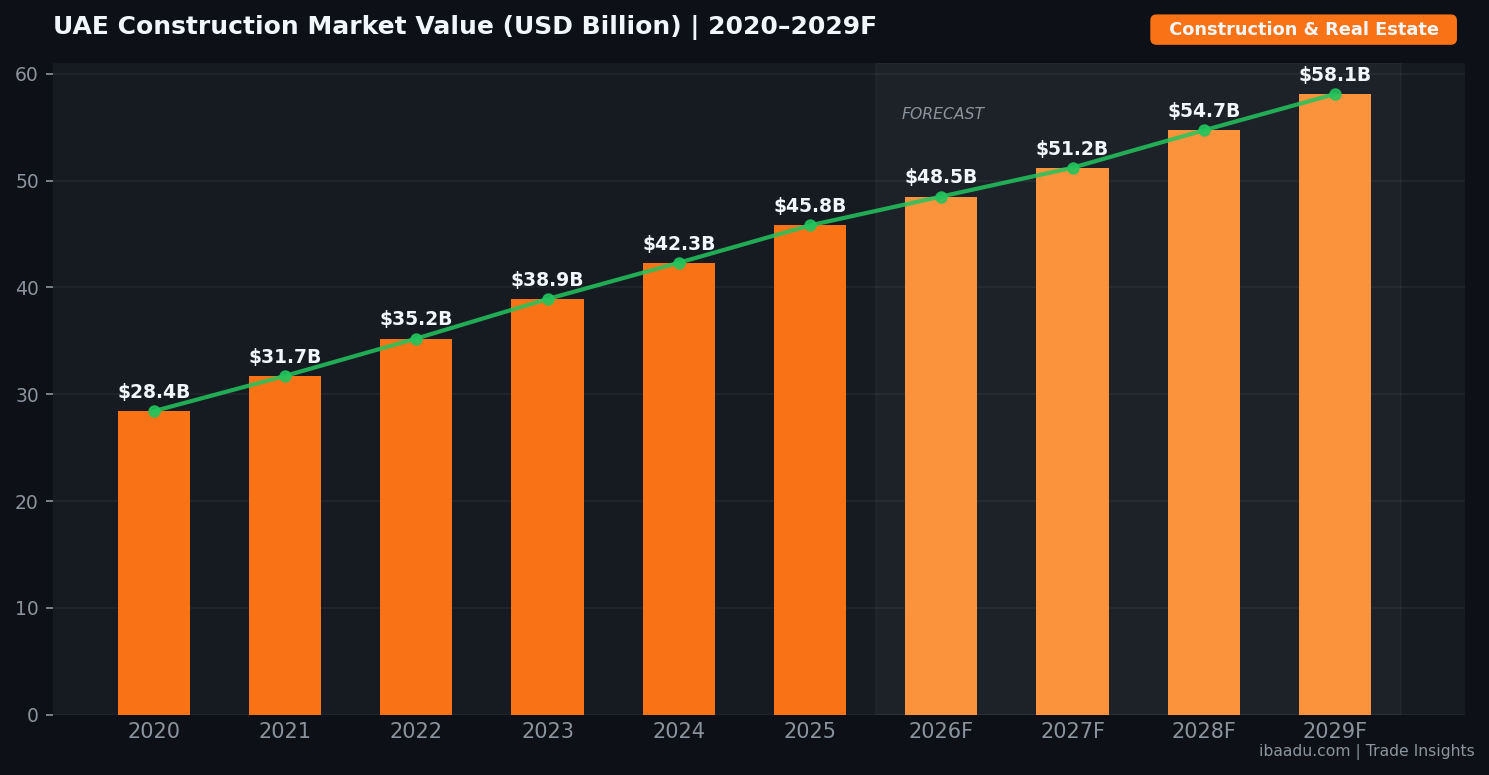
This is the operational reality that's behind the headline numbers. The UAE's construction market was valued at USD 45.8 billion in 2025. It's on track for USD 48.5 billion in 2026, and industry forecasters including IMARC Group project it'll reach USD 69 billion by 2034. Those are exciting statistics for contractors and developers. For procurement professionals, they translate directly into pressure: more projects, bigger scopes, tighter timelines, and a finite pool of qualified regional suppliers who've been through the approval wringer enough times to be trustworthy.
The $45 Billion Reality: UAE Construction in 2026
The scale of active construction in the UAE right now is genuinely hard to wrap your head around. Etihad Rail's 1,200-kilometre network — connecting all seven emirates — is in full execution phase, with a projected GDP contribution of $44 billion and carbon reduction targets of 70%. The Dubai Economic Agenda D33, which targets doubling the emirate's GDP to AED 32 trillion by 2033, is driving a relentless pipeline of mixed-use, hospitality, transport and industrial developments that aren't slowing down regardless of global economic headwinds.
What's changed in 2026 compared to the boom cycles of 2007 or even 2014 is the sophistication of the procurement infrastructure — or rather, the pressure to build that infrastructure faster than the projects themselves are moving. Main contractors like ALEC, Six Construct and China State Engineering are managing approved vendor lists that run into hundreds of categories. A single residential tower project in Dubai Creek Harbour might pull from 40 different material suppliers, 15 subcontractors and a handful of specialist consultants — all of whom need to be vetted, contracted and performance-monitored in parallel.
The projects themselves break down roughly as follows in 2026: infrastructure and transport represents the single largest spending category at approximately 35% of market value, driven by rail, road expansion and utilities. Residential construction accounts for around 30%, with demand from Dubai's population growth trajectory (the city is targeting 5.8 million residents by 2040). Commercial and hospitality — hotels, malls, offices — makes up about 20%. Industrial and logistics facilities, particularly in zones like KIZAD, JAFZA and Abu Dhabi's industrial city ICAD, account for the remaining 15%.
What does this mean for suppliers? It means that if you're selling anything from structural steel to HVAC equipment to specialist waterproofing membranes, the demand side of the equation in the UAE is as healthy as it's been in a decade. The constraint isn't demand — it's access. Getting your products in front of the right procurement decision-makers, at the right stage of a project cycle, is the actual challenge.
The UAE's construction market growth isn't just a Dubai story either. Abu Dhabi's investment pipeline — driven by ADNOC's downstream industrial expansion, the Guggenheim Abu Dhabi museum complex, and significant public infrastructure investment ahead of the emirate's 2031 targets — is contributing substantially to the national market size. Sharjah and Ras Al Khaimah are both seeing accelerated residential and industrial development, with RAK's ceramics and construction materials cluster becoming a genuinely important supply chain hub for the broader Gulf. The procurement geography has spread, which means buyers are searching wider for verified regional suppliers than they were five years ago.
Where Procurement Teams Are Actually Struggling
Here's an insight that surprises even experienced Gulf procurement professionals: the biggest inefficiency in UAE construction supply chains isn't price volatility or logistics — it's vendor qualification lag. Procurement managers at major EPC contractors report spending, on average, between 6 and 12 weeks qualifying a new supplier before they can even issue an RFQ. That's three months potentially added to a project timeline just to get a new vendor onto the AVL.
The qualification process itself has become more stringent since several high-profile material failures on Gulf projects in the 2019–2022 period. UAE Municipality approvals, third-party test certificates, ISO 9001 certification, DCCI registration, and often a site visit or factory audit are all standard requirements now for any supplier wanting to work on Tier 1 or Tier 2 projects. International suppliers in particular underestimate this compliance barrier — which is why so many European or Asian manufacturers with excellent products never manage to crack the Gulf market despite repeated attempts at trade shows.
The second major pressure point is payment terms and cash flow. UAE construction contracts have always had challenging payment structures — 60 to 90 day payment terms are standard, and retention of 5-10% of contract value is held until defects liability periods expire. For small and mid-sized suppliers, this creates a working capital strain that can be existential. The UAE's B2B BNPL market — projected at USD 1.97 billion and expanding rapidly — is partly a direct response to this structural issue in the construction supply chain, with platforms beginning to offer trade finance products aimed explicitly at construction material suppliers.
Third, and perhaps less discussed, is the specification-switching problem. Architects and consultants specify products during design phase that then get value-engineered out during procurement because of price, availability or lead time constraints. A procurement team may go through two or three rounds of supplier searches for the same product category before settling on a solution that works technically, commercially and logistically. This creates churn in the supply chain that's costly for everyone involved.
Can your procurement process afford to keep repeating this cycle on every project? Most can't. Which is why the shift toward pre-approved B2B supplier databases — curated, searchable, with verified contact information and product specifications — has accelerated so sharply in the past two years. The procurement operations that have adopted digital-first sourcing approaches are consistently delivering faster project commencement times than those still relying solely on legacy relationship networks.
There's also a talent dimension to this problem that doesn't get enough attention. The UAE construction sector runs on a genuinely international procurement workforce — you'll find procurement managers from Egypt, India, the UK, Jordan and Lebanon all working on the same project. Cultural and relationship norms around supplier selection vary enormously across these backgrounds. Standardising sourcing processes through digital platforms that enforce consistent verification criteria helps large contractors manage this complexity without losing the flexibility that experienced procurement professionals bring.
How Mega-Project Sourcing Actually Works in the Gulf
If you've never worked on a Gulf mega-project procurement team, the actual mechanics might surprise you. The process is simultaneously more structured and more relationship-driven than procurement in most other markets. Formal tendering processes exist and are rigorously followed — but the suppliers who win are almost always the ones who've already built relationships with the procurement team before the tender goes out.
There are three main sourcing channels that procurement teams in the UAE use in 2026. The first is the incumbent preferred supplier list — companies that have worked successfully with the contractor before and whose performance records are already in the system. These suppliers get the first call when a new project kicks off, often before any formal procurement process begins. This is why new market entrants find it so hard to break in: the relationship capital required takes years to build.
The second channel is trade events. The Big 5 Dubai, Cityscape Global, ADIPEC and specialised procurement summits are the major venues where procurement professionals and suppliers meet face-to-face. These events are genuinely important in the Gulf in a way they're not in more digitally mature markets — a conversation at a stand at The Big 5 can lead directly to an RFQ six months later. DP World, ADNOC and Emaar all have procurement representatives at these events specifically to scout new suppliers. The problem is frequency: major events happen once or twice a year, which means there's an enormous gap between formal sourcing windows for new market entrants.
The third — and fastest-growing — channel is digital B2B procurement platforms. This is where the market is moving, and for good reason: it solves the discoverability problem that makes the first two channels so relationship-dependent. Instead of waiting for a trade show or hoping a contractor already knows your company, suppliers can list their products and capabilities on a verified B2B marketplace and be found by buyers who are actively searching. The key word there is verified — buyers don't want to wade through unqualified listings. They want to find suppliers who've already been screened for basic commercial legitimacy.
Platforms like ibaadu.com's supplier directory are designed specifically for this Gulf B2B context — connecting regional construction buyers with suppliers across all major material categories. The shift toward digital sourcing has been accelerated by the post-pandemic normalisation of remote procurement processes, with teams now comfortable making initial supplier contacts and conducting preliminary due diligence digitally before moving to in-person meetings for the higher-value decisions.
One nuance worth noting: in the Gulf, digital sourcing hasn't replaced relationship-based procurement — it's layered on top of it. The most effective procurement teams are using digital platforms to widen their initial discovery pool, then applying their relationship-building skills in the follow-up phase. The technology handles the scale problem (finding 20 qualified candidates); the human element handles the trust problem (selecting the right two or three to work with). It's a hybrid model, and it's working.
Category-by-Category: What's Being Procured and Where
Understanding where the actual procurement volumes are in UAE construction in 2026 requires breaking it down by category, because the dynamics are very different across segments.
Structural steel and rebar remains the single highest-volume commodity in UAE construction procurement. Emirates Steel — now part of ADNOC's industrial portfolio — is the primary domestic UAE supplier. SABIC's steel products dominate the Saudi side. International competition from Turkish, Indian and Chinese mills is fierce, with price volatility of 15-25% year-on-year creating real procurement headaches for project teams trying to set budgets 18-24 months in advance. Buyers who lock in forward contracts 6-9 months out tend to come out significantly ahead on large-volume projects, but this requires both commercial confidence and strong supplier relationships. Find steel suppliers on ibaadu.
MEP systems — mechanical, electrical and plumbing — represent the highest-value specialist procurement category on most building projects, often accounting for 25-40% of total building construction cost. The Gulf MEP market has a handful of dominant subcontractors but a long tail of mid-tier suppliers competing hard for package deals. Air conditioning equipment, particularly chillers and VRF systems, is where the most intense competition happens. Carrier, Trane, Mitsubishi and Daikin are all aggressively pricing for UAE projects, and the spec-to-procurement journey on HVAC alone can involve four or five different stakeholders across consultant, main contractor and specialist subcontractor tiers.
Fit-out and interiors is where the UAE's project pipeline creates enormous B2B opportunity for international suppliers. Dubai's hospitality expansion — Emaar, IHG, Hilton and Marriott all have significant new hotel pipelines — and the residential luxury segment require specialist fit-out materials: Italian marble, German bathroom fixtures, specialist flooring, custom joinery. Main contractors often delegate fit-out procurement to specialist interior contractors, creating a secondary layer of procurement relationships that's harder to map but commercially very significant.
Construction chemicals — waterproofing, admixtures, sealants, epoxies — is a high-margin, specification-driven category where suppliers like BASF, Fosroc, Sika and local players compete intensively. Getting specified by consultants during design stage is critical; once a product is specified and approved, procurement is relatively straightforward. But getting specified in the first place requires direct engagement with design consultants, which is a different sales challenge entirely from the standard construction materials sourcing process.
Smart building technology is the fastest-growing procurement category in the 2026 UAE market. Building management systems, IoT sensors, energy monitoring platforms, access control and security systems are now standard specifications on any commercial development of consequence. This category is dominated by international technology companies — Siemens, Honeywell, Johnson Controls — but there's growing space for specialist regional integrators who understand the GCC compliance landscape and can provide local support during operations.
Logistics and warehousing for construction materials in the UAE has become a market in its own right. JAFZA and KIZAD both offer specialist construction material storage and distribution capabilities, and the logistics complexity of coordinating just-in-time delivery to live construction sites across the UAE demands specialist providers. ibaadu's logistics category lists freight and warehousing providers across the GCC who understand construction project timelines and the specific requirements of site delivery.
The Vendor Problem and How Smart Buyers Solve It
Let's be direct about something the procurement industry doesn't always like to acknowledge openly: a significant proportion of suppliers who present themselves as qualified Gulf contractors or material suppliers aren't. This isn't unique to the UAE — it's a challenge in every fast-growing construction market — but the speed of growth here, combined with the internationalism of the supplier base, makes it acute.
The vendor problem takes several forms. There are companies with impressive-looking documentation that are, in practice, trading intermediaries with no real product knowledge or quality control capacity. There are suppliers who've cut corners on certifications — presenting expired or inadequate test certificates that look legitimate on paper but don't hold up to scrutiny. There are genuine manufacturers who are perfectly qualified technically but have no real Gulf experience and will struggle with the practical realities of a live UAE project: customs clearance timelines, local municipality testing requirements, the dynamics of contractor relationships on site.
Smart procurement teams solve this through a combination of digital verification and peer reference networks. Digital verification — checking that a company's trade license, ISO certificates and product approvals are current and authentic — is table stakes now. Most major contractors have their own systems for this, and third-party verification services have grown significantly. But the peer reference network — actually talking to other procurement professionals who've used a supplier on a comparable project — remains the most reliable signal of real-world performance.
This is precisely what a well-run B2B marketplace enables: not just discoverability, but a credibility verification layer that reduces the risk of a bad supplier decision. When buyers can see that a supplier has traded successfully with other buyers in the same market, the qualification process shortens dramatically.
There's also a risk management dimension to vendor sourcing that goes beyond the procurement team itself. Project finance providers and development fund managers are increasingly requiring evidence of supply chain due diligence as part of project approval processes. Being able to demonstrate that your supplier base has been sourced through a verified B2B channel isn't just good procurement practice — it's becoming a financial compliance requirement on certain project types.
Source construction suppliers across the GCC
ibaadu.com connects procurement teams with suppliers across steel, MEP, fit-out, chemicals, logistics and all major construction categories. Free to search. Contact suppliers directly.
Find Suppliers on ibaadu →Connecting Buyers and Suppliers in the Gulf B2B Market
The UAE construction market in 2026 sits at an inflection point. The project pipeline is the strongest it's been in a decade — Vision 2031 infrastructure, D33's residential and commercial development, Abu Dhabi's industrial expansion through ADNOC and its subsidiaries — but the supply chain infrastructure that supports procurement hasn't kept pace. The traditional sourcing channels are being supplemented by digital B2B platforms, but adoption is still uneven across contractor types and procurement teams.
For suppliers — whether you're a UAE-based manufacturer, a GCC distributor, or an international company looking to enter the Gulf market — the question isn't whether to invest in digital B2B presence, it's how fast to move. The buyers are already searching online. Procurement managers in their 30s and 40s, who've grown up using professional digital tools, don't wait for trade shows to discover new suppliers. They search. If you're not findable through a verified B2B channel, you're invisible to a growing proportion of the market.
For buyers — procurement managers, project directors, quantity surveyors, purchasing officers — the verification layer is everything. A supplier database with 10,000 unverified listings is actually less useful than a curated directory of 500 companies that have been checked for basic commercial legitimacy and have a trading history in the region. The signal-to-noise ratio matters enormously when you're trying to source 40 material categories under time pressure and budget scrutiny.
The procurement professionals who'll be most effective in the UAE's 2026 construction market are those who've built a hybrid sourcing model: strong incumbent relationships for the high-value, long-lead categories where trust is paramount, combined with digital B2B sourcing for the broader universe of materials and services where speed of discovery and verification matters more than historical relationship. Neither channel alone is sufficient. Together, they create a procurement capability that can actually keep pace with a $48 billion construction market that shows no signs of slowing down.
If you're a supplier looking to reach Gulf construction buyers, or a procurement team looking to expand your vendor pool, ibaadu.com was built for exactly this market. The platform focuses on the Middle East B2B trade context — the verification standards, the cultural dynamics, the project-based procurement cycles — that generic global marketplaces don't understand. Browse suppliers across all construction categories, or list your company and reach active buyers directly. The ibaadu team is also reachable on WhatsApp at +971 4 832 2427 for fast answers on specific sourcing questions.
Frequently Asked Questions
What is the size of the UAE construction market in 2026?
The UAE construction market was valued at USD 45.8 billion in 2025 and is forecast to reach approximately USD 48.5 billion in 2026, growing at a CAGR of 4.66% through 2034, according to reports from IMARC Group and GlobalData.
How do procurement teams source construction materials in the UAE?
UAE mega-project procurement teams use three primary channels: incumbent preferred supplier lists built through prior project experience, trade events like The Big 5 Dubai and Cityscape Global, and digital B2B platforms like ibaadu.com for broader supplier discovery and verification.
Which construction categories have the highest B2B procurement demand in UAE 2026?
MEP equipment, structural steel, HVAC systems, fit-out materials, construction chemicals and smart building technology have the highest B2B procurement volumes in the UAE's 2026 project pipeline, with MEP often representing 25-40% of total building construction cost.
How can international suppliers enter the UAE construction supply chain?
Register on verified B2B platforms like ibaadu.com to reach UAE buyers, obtain relevant certifications (ISO 9001, UAE Municipality approvals), attend The Big 5 Dubai, and consider partnering with local trading companies who can handle last-mile distribution and local compliance requirements.
Bottom Line for Gulf Procurement Professionals
The UAE's construction market is in the middle of its most sustained growth cycle since the Burj Khalifa era, and the supply chain is under pressure to match it. The $45.8 billion in 2025 spending, growing to a projected $69 billion by 2034, represents an enormous commercial opportunity — but only for suppliers and procurement teams who've adapted their sourcing models to the realities of 2026. That means verified digital presence, faster qualification processes, and B2B channels that reflect how Gulf procurement professionals actually search for and evaluate new suppliers today.
Whether you're sourcing steel for a Dubai infrastructure project, MEP equipment for an Abu Dhabi hospital, or specialist fit-out materials for a luxury hospitality development, the fundamental challenge is the same: finding suppliers you can trust, fast enough to meet project timelines, at prices that keep your bid competitive. That's the problem ibaadu.com is built to solve for the Gulf's B2B construction market.
Ready to source smarter across the Gulf? Chat with ibaadu on WhatsApp → +971 4 832 2427